Mostrando las entradas con la etiqueta in english. Mostrar todas las entradas

28 ago 2012

A ROAD TRIP THROUGH NORTHERN VIETNAM - Part 2


Day 3: Thuan Chau – Dien Bien Phu: 136 km, 4 hs.

Good Morning Vietnam!
Our plan for day 3 was to cover some 140 kilometers almost to the border with Laos and spend the night in the town of Dien Bien Phu. It is known for a significant battle that took place around there in 1954 the result of which was the expulsion of the French rule over the north of Vietnam. Since we had plenty of time and a relatively short distance to cover for the day we took time stopping many places to photograph the luscious landscape that was becoming more mountainous and wooded. There were fewer villages around those parts, but every time we saw villagers they were busy with some sort of agricultural activity – gathering rice, carrying or cleaning crops on tarps spread along the road. 

Photo Lessons...
The kids often road water buffalos alongside the road or zipped around on bicycles (2-5 people on 1 bike) way too big for their size. We saw several women who were “transporting” their pigs by walking them on a leash from one place to another. Those villages, situated along the road, were obviously not isolated from the rest of the civilization, but it felt as if they were entirely self sufficient. Every household had a pond where they raised fish and eatable algae and other water plants eaten as salad. They all had cattle, chickens and cultivated their own rice. I am sure that the real situation is not that ideal, but it really felt that those people lived independently relying only on themselves and their land.

A Girl from Sapa.
By 1pm we were almost at our final destination and it was time to eat. When we set out on our trip we were told to respect Vietnamese meal times because otherwise we were not going to find places to eat. Lunch is usually eaten between 11am and 1pm after which most eating establishments close and only reopen for dinner between 6 and 8pm. This time our lunch turned out to be a full on multiple course meal culminating with traditional green tea and pipe smoking. We were hosted by an ethnic family, who did not question whether or what we wanted to eat, but just began feeding us.  Skillfully, they made sure to get our heads spinning with the rice liquor and our bellies full with the fresh deliciousness of no less than 6 dishes during a couple of hours of intense conversations through hand gestures. The whole feast ended up costing a ridiculous amount of $10 after which we could not summon up for anything except for finding a hotel and taking a 3 hour nap.  


a
Limestone Mountains...
Day 4: Dia: Dien Bien Phu – Lai Chau: 212 km, 8 hs.

This was one of the longest days we had on a bike and I was not feeling too happy about it. As the landscapes were getting more and more stunning, my butt was getting more and more sore. We took several stops during which I had to take short naps to try to get some strength back, but it seemed that my body was refusing to take any more time on top of that thing. Emi did not feel the effects as much, but I think it was because he was the one driving, and being in control took his mind away from his pains and aches.  Thankfully, the scenery was gorgeous and diverse with plenty of things to distract ourselves with.

On Their Way to the Rice Fields.
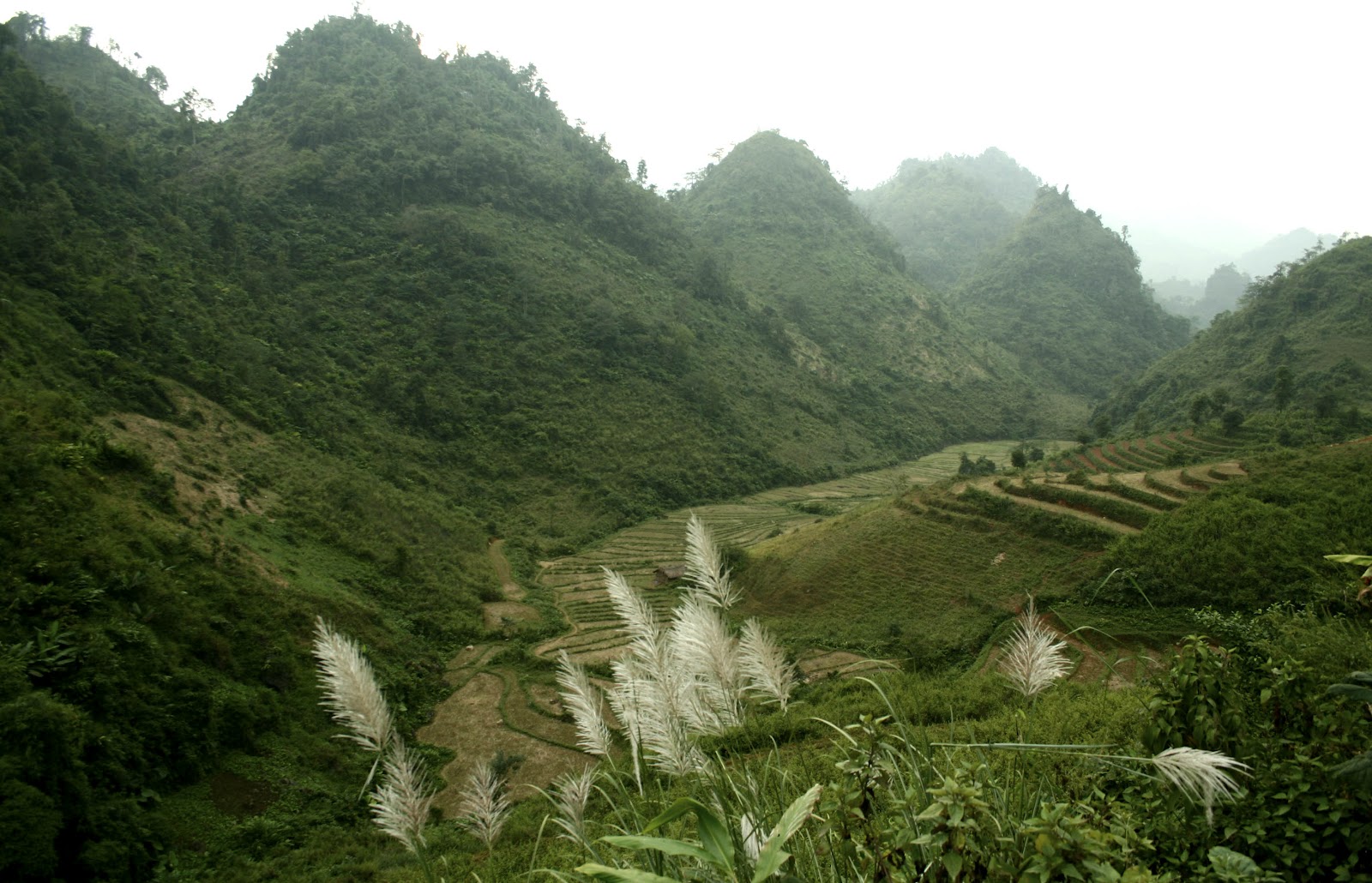
Alongside the road we were on there was a steep wall of a limestone mountainous formation completely covered with a green carpet of voluptuous vegetation. The other side of the road dropped down to a wide turbulent river the color of milk chocolate. There were strange looking wooden boats with some sort of sheds floating in many places. Those boats, as we later found out, were gold-digging vessels that sifted through the river bottom residue in search of this precious metal. As we moved farther and farther north, we noticed that traffic almost dropped completely up there and it was almost strange to come across a random truck of another motorbike. Apparently, the north of Vietnam is less populated and people have fewer resources to contribute to long distance traffic.  

Yummm!
As always, we stopped for lunch at a place that appeared the most popular with the locals. We walked in and were immediately offered to try someone’s dish – an unknown something looking like a pile of golden French fries. Emi put one of those things into his mouth and immediately ordered that dish for our table. Little did I know that in some 5 minutes I was going to be facing a challenge of eating a plateful of giant deep-fried maggots and flies! OMG! The flies had wings and everything!  If I knew what we had ordered this would have never happened, but now, with the whole place staring at us we had to eat them… I am not picky about my food and my stomach is very strong, but I did feel it turn when I grabbed one of those crispy flies with my chop sticks. Of course I had to prove to myself, Emi and everyone else that I could do it….and I ate one fly and one maggot (yuck!!!).  They do taste like fried food and they fill you up, but I would not be eating them any time soon again.

 Just Another Day in the Mud Pool!
Our adventure for the day was not exactly over with the insect lunch. Once we finally got to Lai Chau, I was desperate for a shower and a bed. We found a beautiful room at a family hotel and were ready to settle in when the owner asked us for our passports to register. 5 minutes later he showed up in our room telling us that we had to leave…Since no one at the place spoke English we never found out what happened and why we were being kicked out. Our only guess was that guests with US passports were not welcomed there. The north of Vietnam is still very communist and the memories of the Vietnam War are still too fresh in the older generation’s memory. In general, the Vietnamese are very friendly to anyone and we have not heard any stories about animosity towards US visitors. However, I would not be surprised if that man refused to extend his hospitality to visitors from the nation that did horrors to his homeland and his people.

Day 5: Lai Chau – Sapa – Lao Cai: 157 km, 5 hs.

Villages Around Sapa.
This day we saw some of the most beautiful landscapes and some of the ugliest manifestations of “cultural tourism”. We were now in the mountains of Vietnam and the whole way to Sapa we were climbing up the curvy mountain roads. In many places the roadside slopes were covered with a green carpet of a plant called Xuxu. It is a pear-like wrinkled green vegetable that grows on vines. The plants are grown on hillsides over some sort of an elevated wood and wire platform that supports the vines providing for space to walk underneath the growth and collect the hanging fruit. We have eaten Xuxu many times, as it turned out, but just did not know what it was. It is used for salads and stir fries and it is delicious!

An Indigenous Woman in Some Village. 
By noon we were approaching Sapa, which is a small town on top of a mountain and surrounded by countless hills ornately carved by rice terraces. In the last years it has become a very popular destination for so called “cultural tourism”, when you are offered to visit local villages and get acquainted with a traditional way of living of the native population. Predicting the crowds and the exaggerated prices we had planned to spend an afternoon in Sapa, but find accommodations for the night at a different town further down the road. As soon as we entered Sapa we were happy about our decision as the streets were flooded with white visitors and herds of indigenous locals harassing them. Most of them offered beautiful handcrafted goods or guided walking tours though the surrounding villages and elaborate rice terraces.  

Unfortunately, any interaction with the local people turned out to be negative. Emi went to the market square to look at the crafts and within seconds he was surrounded by at least 20 women shoving their crafts into his face and shouting over each other to get his attention. 
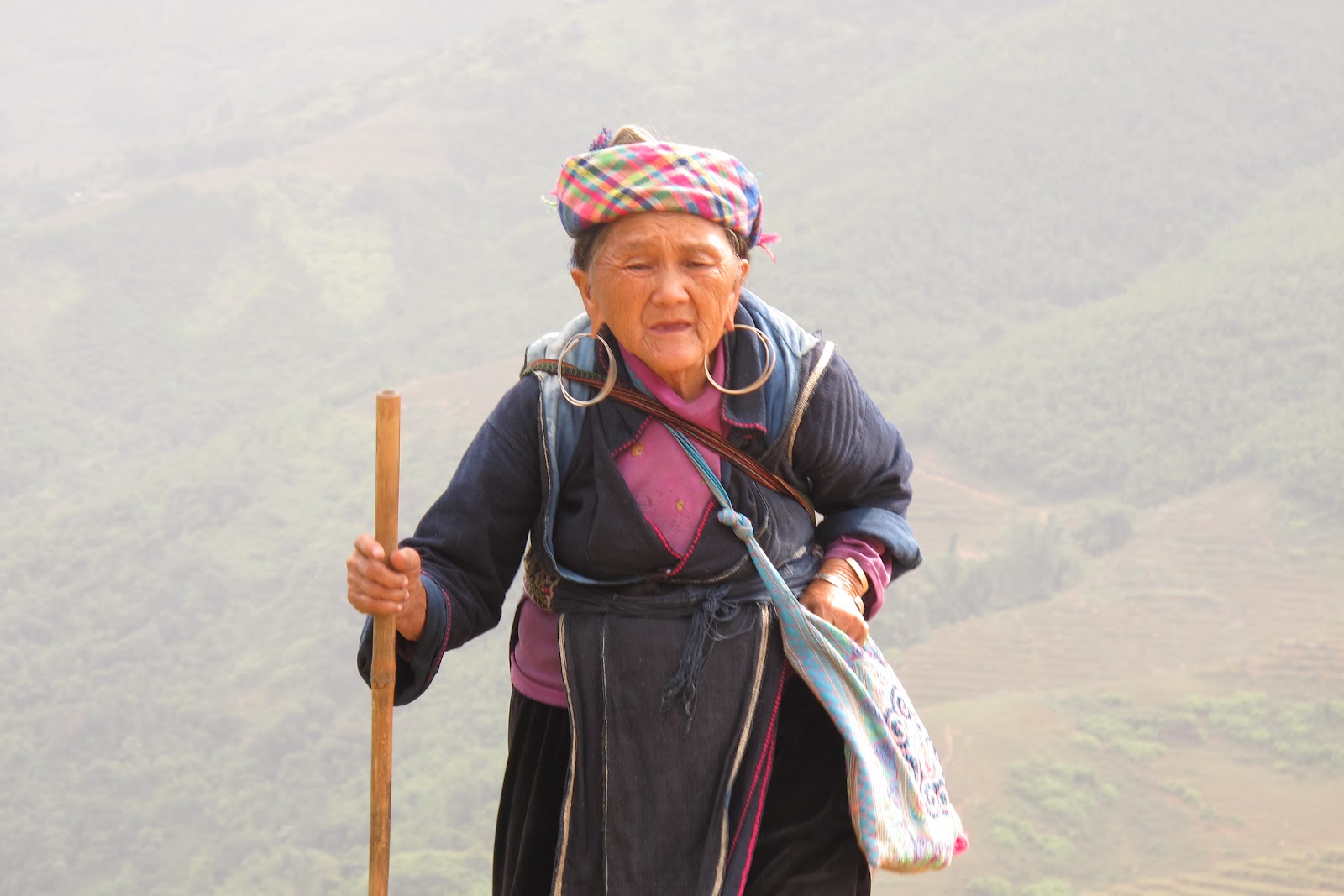
A Woman from Sapa.
The worst part was that they fought with each other and did not respect each other’s prices or priority as far as making contact with a particular tourist. It was also practically impossible to “shop around” and check out prices because as soon as you asked “How much?” you were expected to buy the thing no matter what, and if you tried to leave they physically blocked your way! This was the worst harassment I have ever experienced and it was really sad because it made you want to run from the place that is amazingly beautiful, with rich history and nice people (I am sure).  It really felt like “cultural prostitution” the way those women used their traditional clothing to get your attention and then sell you anything from what they wore or owned.

Another Indigenous Woman Selling Crafts. 
 It was very sad and unpleasant, but this is Sapa’s reality which was created by the western visitors. So we are to blame ourselves for wanting to see exotic beautiful places and people, and creating mass tourism to these places. We are the ones who change the traditional life style in places like Sapa, and now we are the ones who criticize the locals for losing their authenticity and trying to make money off of us?!

Luckily, our visit to Sapa was soothed by a visit to a small local bar with refreshing beer, super friendly owners and plenty of paint to add our contribution to the decoration of the place. Having replenished our forces and done with sightseeing for the day we left for Lao Cai, which was going to be our last stop before heading back to Hanoi.

A Village Woman somewhere before Sapa.  
Day 6: Lao Cai  - Hanoi: 354 km, 8.5 hs. 

The last day was going to be the longest day riding and the poorest one in attractions. This time, the goal was not to see things but to get to Hanoi as soon as possible and in one piece. We actually had an option to avoid driving the bike back and take a train, but that, of course, was an ungrounded extra expense for our budget. So we got up and drove… all day long! It was not particularly interesting and exciting, as we were on one of the main highway routs in the north, but because of that we saw more exciting atrocious variations on driving Vietnamese style… There were people on motorbikes carrying slaughtered pigs, cages with chickens and dogs; there were cows, buffalos and people walking on the highway; we had to swerve around a bus going backwards in our lane; but the best was a heavy-duty commercial truck parked on the actual road while the driver was having lunch.  Nevertheless, as always, we never saw one accident and no one appeared stressed about traffic.

A Perfect Turn on the Road!
By 6pm we were back in Hanoi, which met us with its usual energetic chaos. Very tired but reenergized emotionally by our new tip experiences we returned the bike, arranged a new adventure for Hallong Bay the next day, picked up our big backpacks from our old host and dripped them of at the house of our new hosts - this time 4 French university students. They were very new to Vietnam, so just like that Catalan couple, we were now the ones sharing our road stories and inspiring the newcomers not to stick to established tourist routs and get on those bikes to explore the country for themselves...

1 ago 2012

A ROAD TRIP THROUGH NORTHERN VIETNAM - Part 1


Rice fields in Mai Chau.
This road trip was something very special in our year of traveling. This was probably one of the most authentic experiences we have had traveling.

Emi and I were sitting in a gloomy hotel of the capital of Mongolia waiting for my Chinese visa. As I was making dinner I noticed that Emi was in a very lively conversation with a couple looking very Spanish. They turned out to be Catalans on their back home after more than a year of traveling. The conversation was move like a river of information being poured over Emi about a must do motorbike tour in Northern Vietnam. Martina and Sergio told us how that impulsive trip ended up being their favorite part during their whole 12 months of wandering around the world. Needless to say, Emi was sold on repeating this journey as soon as he heard the stories of deserted mountainous roads, hundreds of indigenous villages on the way, valleys of rice fields and no white foreigners around.

A Rest Stop Somewhere.
Once in Hanoi, we were into the preparations for the trip. Ironically, it turned out that Katya, our host in Hanoi, knew all about independent moto trips through the north as her ex-boyfriend was the owner of a motorbike rental place that set up most foreigners with all the necessary gear and information. The Catalans rented their motorbike form the same guy as well. The trip was going to be a little over 1000 kilometers that we were hoping to cover in 5-6 days. It could have been much longer if we decided to continue on and explore the north of the neighboring Laos, but at the time we decided that a 6 day loop was going to be enough of an adventure.

Day 1: Hanoi – Mai Chau: 188km, 6hs.
On the Way Home from School.
Leaving Hanoi was easy, but long… Everyone drives at the speed of 5km an hour and there is traffic of all kinds at all hours. We left early to avoid the peak of congestion, but that did not help much. Nevertheless, thanks to Emi´s amazing navigation skills we did not get lost once and eventually got out of Hanoi in the right place. Our first overnight stop was planned for Mai Chau, some 100 km southwest of Hanoi. We got there a few hours before sunset, which was not exactly planned this way, but worked out perfectly because the place is absolutely stunning and it would have been a huge loss not to be able to document it in photos. The place is known for its traditional tall stilt houses spread over luscious rice fields. In the golden pre-sunset light the village and the valley looked as a perfect scene from National Geographic. The people turned out to be also extremely friendly and welcoming, even though it is very touristy. Mai Chau is the closest traditional Vietnamese village to Hanoi, so busloads of farang tourists are delivered there daily. The Catalan couple, as well as many other independent travelers, prefer to stay away from such touristy places for this reason, but we felt that following this logic we would be robbing ourselves of seeing some of the most amazing places in the world. So, despite the white grandmas walking along narrow dirt village paths, we were happy we did not skip Mai Chau. It was surreally beautiful!

Rice Harvest.
Despite its popularity with tourists, the village still lives by its agricultural traditions. When we arrived, it was harvest time and we got to see how rice was separated from its husk and hey. Most of it was done manually by beating the rice plants against the ground and stepping on it, or with a mechanical beating machine, which is operated by a pedal, much like an old pedal-operated sewing machine. Sometimes a few families collectively rent an industrial electrical device to process their rice, but since we did not see much of it, it must be expensive for the farmers, so most of the rice is planted cared for, harvested and separated manually!

Some Local Ladies.
Another reason why we wanted to go to Mai Chau was because we wanted to stay with a Vietnamese family and learn a little about their life and the way they do things. We did not have to look for a place to stay as the first guy who appeared at the entrance of the village persuaded us to stay with his family. The stay also included a dinner and a breakfast, which was just perfect. The meals in Vietnam always consist of rice accompanied by multiple dishes served for everyone to share. The individual plates are not really plates, but are small bowls which you refill several times during the meal. The utensils are chopsticks or hands. Fruit is commonly eaten as a desert and as a breakfast treat. Breakfasts, as we know now, doesn´t really exist in South East Asia. For them, breakfast is just another meal that is eaten early in the morning (around 6 am), and so it can be a traditional bowl of noodle soup, rice with vegetables and chicken or meat. It is all very delicious, but in the morning…I still prefer my croissants or a toast with cheese!

Day 2: Mai Chau – Thuan Chau: 217km, 7hs.
New Lunch Friends.
With our stomachs full and our butts sore from not being used to spending hours on end on a motorbike we were off. Our goal for the day was to cover some 200 kilometers and spend the night in the town of Thuan Chau. I thought that the farther we got form Hanoi the less populated the countryside was going to get. However, I forgot that we were in Vietnam – one of the most populated countries in the world, with almost 90 million people spread throughout its country side. There were villages along the road almost everywhere. Some looked like small towns and others were just a collection of several wooden huts planted in between fish ponds and rice fields. We also noticed that among the working in the fields there were never children, unlike in some parts of Latin America. We saw them helping out the adults later in the evening, but during the day they were all in school. It appeared that there was a very strong emphasis on education in Vietnam and teachers were very well respected in the society.

In between Villages...
Little by little we began noticing that people were looking differently from one village to the other. We began seeing people wearing characteristic traditional dresses that distinguished them from the natives of the other surrounding villages. Some had long velvet skirts with bight color belts, some wore Andean-like colorful multilayered skirts and embroidered tops, others had special head wear pieces and distinctive hairdos. It was not surprising to me how many different types of ethnic minorities that we saw, but I was shocked at how closely they lived to one another, and how they all coexisted without visible conflicts and animosity. To us, the people were always very friendly and welcoming. Every lunch stop turned into a story of meeting the whole family of the restaurant owners; or some game with the local kids; or a drunken celebration of life with the local field workers, who took their time to enjoy the food, each other’s company, and telling us (in Vietnamese) about their lives. 

30 abr 2012

VIETNAMITAS-DINAMITAS


Traffic Jam!!!
There was no direct bus from Hong Kong to Hanoi, Vietnam, contrary to what Emi has been telling me. Luckily, we cleared that out before getting into China and got ourselves double entry visas for that country.  From Hong Kong there are only 2 options as far as getting into Northern Vietnam – going through southern China or flying. As you might imagine, flying was totally unacceptable for our budget, so it was bus or bus via China. It was going to be our first over-night bus trip, and what a joy it was to experience it with a Chinese transport company. It was paradise compared to all the other “sleeper buses” we took in South East Asia. The bus was new, spotlessly clean, and had real double deck beds wide enough space to accommodate 2 people! It also turned out that the roads in Southern China were very nicely paved and without much turns and curves so it didn’t feel like we were on a bus at all, which presented a perfect opportunity for watching a movie on our little Acer.

A Mobil Fruit Stand.
A movie and a few hours of sleep in we were at the Vietnam border. The border crossing was like any other, but the immigration control and the actual passport stamping was something special… First of all, you have to make it to the little window to hand in your passport, either by waiting in line, or just pushing your way through, as if the rest in line did not exist. Once at your target, somehow you start doubting if it is a good idea to turn your passport in because what you see through the window is a mountain of passports of all colors being stamped and passed over in all directions. You are supposed to submit your passport and wait at the other window where it is supposed to appear with all the necessary stamps and visas. Passport control, as most of us know, also implies “face control” where they match your passport photo with your actual face. Well, not in Vietnam! What matters is a passport and the entry fees you have paid, and there you go! Magically, our passports were into the chaos and back out and in our hand in no more than 30 minutes. The magic here must have had some connection with Emi’s 3 month beard. Contrary to Russia, having a beard and lots of body hair in Vietnam automatically makes you a super star. The Vietnamese of all ages and genders were staring at Emi with approving looks and fascinated smiles on their faces. They must have expedited out passport quickly and into the right hands just out of respect for his abundant hairiness!

Vietnamise Style U-HAUL.
Heading down to South East Asia we, of course, knew that accommodation, among other things, was very cheap there. Nevertheless, we were determined to continue with our couchsurfing home stays. This time, it was Katya from Ukraine who opened her doors for us. Katya, like many other expats in Vietnam, was an English teacher. As we learned later on, life as an English teacher in Vietnam is pretty sweet, with nice salaries and a prestigious social status. So, it is no wander that herds and herds of travel enthusiast, adventures and all sorts of cold hating white folks flock to Vietnam to spread the lingua franca of the current times. Somehow, this communist country places quite an important role on getting its population to master English. There is a great demand for English teachers and they are treated very well in Vietnam.

Farangs at Dolche Vita, no Less.
Nevertheless, despite the abundance of English schools and farangs (or gringos, or white foreigners) the Vietnamese don’t really speak English. I should correct myself, they all do try to speak it, but what comes out of their mouths is impossible to understand, so there is lots and lots of work for anyone whishing to try themselves in the education field. Weeks after our first entrance into Vietnam we were explained the basics of the Vietnamese language, after which it made it much easier to understand why the poor Vietnamese cannot, for the life of them, get their English sounding like they are speaking English. In Vietnamese, half of the consonants, that are perfectly normal to us, simply do not exist, and the Vietnamese can’t distinguish the sound of those consonants. So, for example, v, f and p sound the same to them!

Coca-Cola Delivery Truck.
Listening to all sorts of crazy expat stories while sipping another one of the 25 cent “bia hoi” bears I couldn’t stop thinking about our DC family’s dear friend Leo, who lived in Vietnam for 4 years. The whole time that we were in Vietnam, I saw Leo in every fair-skinned farang drinking a beer, eating a bun cha, or zipping around on a $5 per day rental motorbike. One time, I asked Leo why he left Vietnam, and he said: “I was going crazy, I had to leave”. I can only imagine the kind of trouble my dear friend and the rest of the farangs got and get into in Vietnam with all the money and the freedom of the young years on their hands… Oh my! The crazy mix of everything in the streets only hinted of the chaos Hanoi lifestyle could be.

A Mobil Coffee Shop.
There were motorbikes everywhere and you never knew if the drivers actually knew how to drive them. As we found out, in order to rent a moto all you need is $5 to pay for it. No one is going to ask you for driver’s license, insurance of anything of the sort. I read somewhere that all international drivers license are actually illegal and are not accepted in Vietnam and Cambodia, but in reality, no one cares about any drivers license, and the police are usually afraid to deal with the farangs because they don’t speak English. Most of the locals also don’t have any kind of license and many even drive bikes without any license plates! But again – anything goes in Vietnam. Things like, transporting on a 2 person motorbike a cargo of 10 cages full of live chickens; a live pig; a dead pig; a stack of crates full of beer and coca-cola; a sheet of glass for a storefront; an entire kitchen and a kiosk to sell the goods at any stop; 4-5 people, some of them holding I.V. bags for the others (it is true!), and so on...


A Corner Restaurant.
Surprisingly enough, accidents happen a lot less frequently in Vietnam as one would expect. Once we have gotten a “steel horse” of our own, we realized that one of the reasons for that was that everyone drives very slowly there. It is perfect for when you are learning how to drive a bike, or when you are doing some sightseeing, but not when you are trying to get from point A to point B. However, the biggest challenge is probably not the speed, but what you might encounter on the road. While on a highway (or something of its equivalent) you might see people driving in the opposite direction in your lane; people doing a U turn in the middle of the road; water buffalos, cows and pigs crossing your way, or taking a little siesta; and of course, lots and lots of Vietnamitas-Dinamitas (as Emi likes to call the Vietnamese) all wearing air masks, and some sort of pajama looking protective jackets.

Taking a Little Siesta.
Hanoi, like most other Asian cities, is famous for its bad air quality, however, I have discovered that it can easily compete with Moscow, or Buenos Aires for example. To me, the air in Hanoi did not feel any dirtier than in any other big city. It is just that the Vietnamese feel that it is essential to wear a face mask (and often an all covering pajama-style jacket) in the city to try to protect your lungs from all of the dust and pollution you breathe in otherwise. It certainly looks very strange and involuntarily makes you feel nervous, as if you were in the epicenter of a major epidemic area. Nonetheless, I think they are doing the right thing by trying to protect themselves, and more often than not I feel like wearing a facemask on the overcrowded streets of Buenos Aires where fumes are literally choking during peak hours.

My Favorite Squid Stand.
Pajama fashion is a special phenomenon in Vietnam that deserves a special note. First, I thought that all of the pajamas that I was seeing all around us were out and about because it was an early morning hour. As the day went on, though, the outfits did not change, and the women of all ages continued parading around their multicolored and diversely designed pajama suits. From day to day they changed them, as one would change regular clothing, which indicated that the pajamas were their regular clothes. I never found out where this latest fashion came from and how it became widely accepted, but it was definitely entertaining to find yourself surrounded by pajama fashionistas in the middle of a huge metropolis.

No Worries! Trains don't Come Very Often.
Even though Hanoi is a big city it doesn’t feel that way, despite the never ending chaos in the streets. To me, the reason why it didn’t feel like a big city was because the people continue living the way they live in the villages – with all activities happening in the street, in font of their houses. In fact, in many houses the street is an extension of their living rooms. In most houses, the façade part of the building at the ground floor is a wide garage-like gate that stays open the whole day, as the inhabitants go on with their home lives in the living room space – eating their meals, watching TV, playing with children, or arguing. In some houses, the front entrance is blocked by an abundance of very low plastic table and chairs, which serve as restaurant seating. In Vietnam, most of the people eat in the street, since the food is really cheap and is available 24/7 on every corner.  We discovered that the low seating was not something exclusive to impromptu house restaurants, but was the way/ level at which the Vietnamese did everything. Somehow, for them it is more comfortable to prepare dinner, wash dishes, or do anything else in a squatting position, rather than to do it all standing at a normal size table.

PJs Galore!!!
It was all very different and very exotic and I constantly felt like I was in some parallel world where everything was done in a strangely distinct manner that I never knew existed. These few days in Hanoi ware like a brief introduction for what we were about to experience in those last few months of our trip. South East Asia was opening its doors for us and we were eyes and ears trying to absorb and understand what it was all about. 

1 mar 2012

NEW YORK OF ASIA

The Best Old Trams Ever!
Is it China? Is it an independent country? Is it a British colony? The truth is that even after reading and trying to get a better sense of what Hong Kong’s status is doubts do not fade but grow and leave us with even more questions. A former British colony until 1997 (yes ... until very recently), today Hong Kong is a "Special Administrative District" of the People's Republic of China. The system, developed by Deng Xiaoping, was to maintain a capitalist economic system (implemented during the colonial period) under the sovereignty of a country with a communist ideology, such as China. In addition to the economic system, Hong Kong maintains independent administrative and judicial systems, its own customs and external borders. This is why Chinese citizens have to apply for a special visa (until recently, a nightmare to obtain) in order to enter Hong Kong’s territory.

Wanering Around Hong Kong's China Town.
Luckily, we did not need visas, however we did enter Hong Kong the way most of the Chinese do – by taking a local train from Beijing to the border city of Shenzhen. Long walks through the hallways of the train station (which looked more like an airport) finally brought us to the immigration counters where we legally exited China and entered Hong Kong. On the other side and directly connected to the immigration offices we found ourselves at an entrance to the subway system, which connects you to almost any part of the country (we’ll call it a country, even though it is not). With its gigantic stations, underground and above ground sections of the railway, its super modern soundproof trains with TVs, perfect order and cleanliness, and a unique transfer system where in order to change lines all you need to do it just step out of one train and take another one across the platform going the opposite direction, Hong Kong’s metro is one of the most modern on the planet. In just over half an hour we were in one of the central districts – Kowloon, named after the peninsula where it is located.


Wandering Around Hong Kong Streets at Night. 
Beijing's China disappears completely as soon as you come out of the metro, replaced by a western city with the British legacy, which Hong Kong took advantage of to the maximum. It is true that almost all of traditional Cantonese architecture has been lost, however, this does not take away from the city’s charm inspired by the friendliness of the people, the general order and cleanliness of its streets, the well organized traffic, and the endless skyscrapers. With our mouths open and the eyes looking up into the sky, all we could think of was “Wow! We are New York!”. And yes, Hong Kong is the closest city to the American metropolis we have been to so far. The similarity is not only in the architecture, modern skyscrapers, and the busy crowds, but also in its geographical location. Hong Kong is comprised of the central island (Hong Kong Island) just like Manhattan; a continental area (The New Territories and the Kowloon peninsula) similarly to the New York neighborhoods of Bronx, Brooklyn and Queens, although the latter two are part of the great Long Island; and finally the islands (Lantau and Lama) just like New York’s Staten Island and the others.

Relaxing on one of the Hong Kong Islands.
These first impressions of “another New York” began to change in some respects once we discovered the city a little better. Hong Kong, despite being a big city with its abundance of concrete, steel and glass has protected areas that comprise 75% of the total area of ​​its territory. This means that more than seven million people of the country’s population reside on the remaining meager 25% of its land.  The district of Kowloon is the perfect example of this. In 1991 it reached a historical record of being the largest urban center with the highest population density on the planet (40,426 inhabitants per square kilometer), with 1,900,000 inhabitants living on the territory of only 47 square kilometers. Taking into consideration these numbers, nonetheless, there are many uninhabited areas and whole islands with deserted beaches, luscious forests and pristine quietness to enjoy whenever you feel like getting away from the craziness of the metropolis.

A Quiet Sunset on a Beach 20 min away from the City.
Hong Kong’s Victoria Peak is the place where you can get the best aerial view of what is the inhabited part of the island with its countless skyscrapers seeming completely unreal the way they illuminate the sky with its lights and colors. To get up there we used the famous 120 years old tram installed by the British in order to access their posh residences at the top of the hill. Getting down wasn’t as quick, as we decided to walk through this privileged part of town to get a better feel of what life could be if we were children of some rich Hong Kong Englishman. Amid the lush vegetation it was impossible to see any lights of the city and the silence was almost utopian interrupted only occasionally by birds’ chirping or the piercing sounds of cicadas. The narrow roads, taking us on this evening stroll through colonial English residences nestled between green hills, revealed only a few parked cars, none less in class than a Porsche, a Jaguar or a Rolls Royce. Gradually, the distant city lights began exposing the foliage of trees and in less than an hour we were back to dodging cars and buildings, with our feet on hot cement, and without a single tree in sight. The change was incredible and it was hard to believe that the same city could be so different so quickly.

Hong Kong Getting Ready for the "Symphony of Lights".
The skyline of Hong Kong alone has become one of the main attractions of the city. Organized by the department of tourism, a sound and light show called the Symphony of Lights, happens every night at 8pm and involves many buildings on both sides of the water - the Hong Kong Island and Kowloon. Dozens of dancing lights, lasers and reflectors rhythmically jump from one building to the other, some changing colors and some reproducing phrases on gigantic LED screens. Crowds gather on the Avenue of Stars to watch the skyscrapers become alive for some 15 minutes in a cheerful dance and then fall asleep for another 24 hours.

The City of the Go.
One of the strangest things about Hong Kong, though, was that it made me feel as if I were inside a videogame. Hong Kong highways and air walkways for pedestrians are completely surreal. As if taken directly from the “Need For Speed”, highways that go at ground level suddenly rise to heights of a 3rd or 4th floor, then go snaking between buildings and then cut their way directly through some skyscrapers. At the bottom they are lit with lights and lined with different materials making them look completely futuristic. There, if cars have their highways, pedestrians do as well. Footbridges, elevated to over 10 meters high, transport you between buildings and streets, take you through shopping centers and then deposit you in a completely different part of town. Sometimes the inclination of these bridges is such that they have escalators, which is the case of the one that takes you to the Soho area. With its 800 meters in length and 135mts of gradual elevation it is the longest outdoor escalator in the world. Walking for hours on end in these suspended gateways made me feel as if had been deposited in the middle of futuristic New York of “The 5th Element”.

Midair Walkways.
Thanks to Ting, a Singaporean girl  living in Hong Kong who hosted us for a few days in her 62 floor apartment on the island, we were also able to try Dim Sum (literally translated "order until heart’s content "), one of the favorite foods of southern China. Inside the restaurant there are many large round tables, which are shared by several diners, so you do not look for a table, but rather for a chair. Once seated, you are given a small paper with pictures and names where your orders are recorded as you ask for them. It is done this way because Dim Sum is not just a single dish. Female waitresses dressed in white circle around the tables with carts from which you choose what you wish to try. The variety of steamed buns, such as char siew bao (small bits of rice dough stuffed with different ingredients such as meat, chicken, pork, shrimp and vegetarian options) is enormous and all of it is absolutely delicious. The meal is always accompanied by green tea or Bolay (strong fermented tea) which is present on every table and is included in the price, so you do not have to pay for it separately. Many seniors come to these restaurants with their newspapers and spend hours and hours drinking tea, eating and chatting among themselves, although often barely acquainted only by sharing a Dim Sum table.

Hong Kong from the Victoria Peak.
Hong Kong was captivating and we felt like staying for a lot longer, because despite of its limited territory, the places we wanted to visit and the activities to do were endless. Nevertheless, the high prices and the time limitations made us move onto looking for new routes and destinations in Asia. The start of our exploration of the Indochinese peninsula was coming closer and closer, and the date of our departure for Vietnam was on the calendar. Thus, with the corresponding visas in our passports we left Hong Kong to begin what we call “The Final Stretch of the Expedition - Southeast Asia”.

Translated from the original article “La Nueva York del Oriente” by Emiliano Garcia.

25 ene 2012

THE WEIRD CHINESE

SPA was the only place
I wanted to go anyways!
I have never been to Asia before, so I was particularly acute to some things that jumped at me as something very weird. As soon as we boarded our China bound train it was clear to me that the Chinese are very hungry people. In our 4 person train compartment our Chinese neighbors took a break from eating only when they were deep asleep, which was from about 9pm to 5am (not exactly my schedule). In the morning, that is before sunrise, we were woken up by the sucking sound of the instant noodles being inhaled by our new friends accompanied by a mortal stench of garlic coming from the hallway, where others were shoving in their breakfast favorites. I am not being mean or condescending when I use such strong verbs as “shove” when I describe these eating habits. In China (at least in Beijing) people are always in a rush and they do not appear to let themselves enjoy eating. They eat not to be hungry and do it as quickly as they can. When it comes to noodles, they “inhale” those suckers very noisily in order to cool them down that way. Why not let them cool in a bowl and then eat normally and without the annoying noises?! Oh, and the spitting….! I have never heard so much and so frequently people want to spit stuff out their mouths. Everyone does it from grown men to young children and women. I don’t know if there are sick all the time or just want to attract attention, but it sound and looks so awful that it is extremely difficult to ignore. I am not judging. I guess “it is not good, it is not bad, it is just different”, but way too different for me…

Emi's beard was the #1 attraction on the Great Wall.
As soon we got off the train in Beijing we were reminded that China is a super over populated giant and the land of competition where only the fittest survive.  The Chinese seem to not see/not care what so ever whether there is something or someone in front of them. Whatever that is that is in front of them is in their way, therefore needs to be moved, pushed or removed out of the way. You pretty much have to walk and do things at the speed of the people around you, unless you want to be run over. When people run into you (they do it all the time) they don’t even look at you, let alone say “I am sorry” or something along these lines. The Chinese will always try to push you out of their way to get into a train car, cut you in line to get into a bus, sneak money to a cashier at a grocery store to get the shopping done faster and so on. It is really, really annoying at first, but then, once you learn that there is no such thing as politely letting someone go first, you realize that you just have to make your way through and you start acting the way the Chinese do and everything starts working out for you.

The Red Hat tour group.
Once we have finally settled in and made our rounds in town plazas, markets and walking streets, I have notices a couple of other interesting things. Most of the younger Beijingers are very fashionable and seem to be a little too obsessed with appearance. Fashion I like very much, and it was a breath of fresh air for me to see some interesting clothing on people after months and months that we have spent in south America and Russia. Nonetheless, men’s fashion seemed a little over done for my taste. Besides the latest fashion in their clothing they are absolutely obsessed with their hair. Oh, you should see those hairdos! That is right, they are not just haircuts, but daily styled hairdos with gel, hair spray and whatever else other hair products. The actual haircuts are really quite good and elaborate the opposite of what you might get at a US Hair Cuttery. But it is not the haircuts, but the amount of attention that they received every time those gentlemen left their house that amazed me.

The obligatory "Fire Spirit".
Those guys would also sneak “check up” stares every time they passed a mirror, adjusting the do with their female-like manicured fingers. This is something that I have never seen anywhere else before. Many of the Chinese (and Asians in general, as I have discovered later) keep their finger nails long. Supposedly, it is a sign of a class demonstrating that you are not a peasant who works in the fields. I am sure there is a reason for this and it must be an important one. Nonetheless, I could not (and still can’t) hide my disgust when I see those male hands with long thick fingernails.  I have no idea why it makes me feel this way, because I have nothing against long finger nails on women. Why does it make a difference to me I have no idea, but it does. Personally, I think all of those guys should relax about their hair a little bit, cut their fingernails and they’d be a lot more attractive, even though they are not much of my style.

10 ene 2012

A WEEK IN HUTONGS

Beijing'sTiananmen Square.  
As soon as we crossed the Chinese border, we knew that we were in a country with tremendous population. Every little bit of land, and all the way to the rail ways was taken up by some sort of crops growing everywhere. China met us with sunny skies, warm breeze and hundreds of Chinese coming and going at the main train station square. Arriving to Beijing from Ulan Bator was like making a leap of a couple of decades. Beijing, in contrast with Ulan-Bator, is a very modern, developed and organized city which offers all of the modern comforts without losing its historic flavor. It is enormous and it seems that there is no end to this concrete jungle, however, we did not feel this, even though we stayed in one of the central districts of the Chinese capital. Our Chinese home ended up being a hutong apartment of a Portuguese-Canadian.

Being Chinese.
Chris met us at the Jishuitan station. We did not have the exact address and Chris insisted on us calling him when we were at the station. Of course, we did not have a phone and this was our first country where neither of us spoke a word of the local language. Taking turns we stopped a number of pedestrians pointing at their cell phones. Finally one young girl responded in English offering to borrow her iphone (everyone has an iphone and a professional photo camera on them at all times in Beijing). Three minutes later a guy in shades and a black leather jacket greeted us with a sudden “que pasa?!”. We were taken a back for a second but recovered immediately remembering that the guy was half Portuguese. He didn’t really speak Spanish, but he liked to try. We followed him into a narrow alley, then another one, and another one slowly realizing why Chris insisted on meeting us without giving us the exact address. There was no way in the world that we would have found our way in a maze of those hutons.

Old time hutongs.
A huton is a historical district where people live in traditional houses which had sprouted chaotically in no organized manner, and which keep on expanding forming labyrinth-like shantytown with no central sewage system. Why would I care about sewage? Well, I really don’t unless it complicates my life in a very direct way. Chris’s hutong, just like any other hutong, does not have private bathrooms, which means that every time your body is ready to discard its byproducts you get to go to one of the community outhouse and share this special private time with about 4-9 neighbors happily chatting about the latest rumors, smoking, or playing games on their iphones. Oh no! There are no individual stalls or any sort of devisors between the actual toilets, so you just make your bottom comfortable in a squat position right next to your new Chinese friends.

Besides the minor bathroom time inconvenience Chris’s place was just perfect for our needs. It was right in the center of all of the main attractions of the city and only 3 minutes away from a metro stop.

Inside the Forbidden City.
Since Beijing was a huge city and our only stop in China we decided to spend at least a week there to visit its sights and try to feel through what it is like to live in this gigantic Chinese metropolis. During the day we went about town discovering its treasures like (The Temple of Heaven, the Olympic Village, the Forbidden City and such) and at night, when Chris was back from his lessons (he is an educator of some sort), we all went out for a taste of Beijing in one of its many restaurants. Sometimes they were actual restaurants where we drank obligatory rice wine shots (Chris strongly believes it the disinfecting qualities of alcohol) and ate elaborate dishes with weird tastes. Other times they were just street stalls which magically produced tables and chairs and fed us its kebobs made of unknown substances. Food was always very interesting, however not always agreeable with my stomach. Whether it was the abundance of oil which is used for preparation of practically everything, or the strange herbs that I have never tasted before, but more than once I had bathroom (hutong style, of course!) consequences after those wonderful dinners.

Beijing Night Market.
One time Chris also took us to a local food market and showed us how negotiating is done in Mandarin. After 5 years in Beijing Chris spoke Chinese Mandarin pretty much like a local and knew all ins and outs of the city and its Beijing urban culture. As it turned out, it was pretty important to have someone local, or at least Chinese-speaking to guide us around and bargain down the prices. The locals are quite opportunistic and will rip you off if you are not paying attention or not familiar with their prices. The cabs are absolutely ridiculous. First they do everything possible to not understand where you want to go even if your destination is 10 blocks away and you are pointing at the exact address on a map written in Mandarin, then they refuse to use the meter, and when you finally manage to negotiate the right price and the cab begins moving you realize that the driver is somehow unfamiliar with the area and insists on taking you to your destination taking a detour of at least 30 minutes. 

A rare clear sky sunset in  Beijing.
Luckily, we only had to use a taxi 2 times, one when we were off to the train station on our way to Hong Kong, and the other when we went to meet with Diego, my friend’s cousin.  I have never met Diego, and did not even know that my friend Manuel de Rivera had a cousin who not only lived in Beijing, but also worked there as a reporter for one of the Spanish TV channels. As it goes with the Spaniards, after a quick introduction over the phone we were invited to a dinner and a party with a flamenco singer performance at one of the bars frequented by Beijing expats. Diego turned out to be very charming and welcoming somehow making me feel as if I were at some bar in Madrid, surrounded by Spaniards drinking wine, smoking cigarettes and chattering over the crying sounds of flamenco. Diego told us that there were expats in Beijing of all sorts and that no matter what people did they found a way to make a good living there. The city seemed booming with everything, from commerce to fashion, and from international work to construction industry.

At the Temple of Heaven.
Beijing was bustling and hustling no matter where we went. It also seemed to be flooded with tourist groups, especially Chinese ones. Mid fall is the “golden time to visit Beijing”, as we have discovered later, and many Chinese take their short vacation during that perfect time of year to visit the nation’s capital. Apparently, they don’t like to travel individually, and together in an organized group it also tends to be cheaper. As their vacations are short, the tours are usually short as well, but they are as condensed with activities as can possibly be. A typical tour of Beijing would be one or two days with visits to the Forbidden City, The Temple of Heaven, some parks, the Olympic village the Great Wall and, of course, a dinner of the famous Beijing duck. In size, the Chinese groups could only compare with Russian speaking groups. I was very surprised to hear as much Russian in Beijing as I did. It appeared that Beijing was one of the new hot destinations for vacationing Russians, whom I could identify anywhere, whether I heard them speaking Russian or not. No group was without a typical middle age woman of about 100 kg, wearing a see through shirt, large sun glasses with sparkles and an awful haircut. There was always a man in his 40s with very pale skin beige color shorts, back socks and sandals, tugging behind himself an identical copy of a son. And, of course, no tour could go without a group of 3-4 bolding men in their 30s-40s with beer bellies, cigarettes in their mouths and terrible smell of sweat floating behind them like an invisible cape of people repellent. We spent a week visiting all of these places and it still felt rushed,  especially because I were constantly forced o fight for space with the never ending tour groups.

The Spectacular Bird's Nest.
One afternoon, returning from another museum we found ourselves in a beautifully groomed park which was full of people. There were some obvious tourists, but the majority were locals who were intensely involved in activities. It seemed that that park was a meeting place for people to practice their hobbies and socialize. There was a terrace for card players and Chinese chess lovers, there was an “exercise station” with different cardio machines (with free access), there were open spaces full of older people practicing Chinese gymnastics (very weird looking set of activities when you swing of arms and hit yourself on different parts of your body), there were others who stood in circles and played hacky-sac with a mysterious device which had feathers and flied like a badminton shuttlecock  (which they were ridiculously good at).  

A woman in a Bejing hutong.
All of this business was very different and terribly exciting, but the most impressive of all activities was opera singing. I know, it is weird to be polishing your arias of Aida in a public park, but that is what they do in Beijing. First, we thought that we did, in fact, stumble upon a group of professional opera singers practicing their singing in the park just for the hell of it, but then we realized that there were many of those groups, each with an accordion player, and some competing with each other (let’s sing our loudest to outsing those around that bench right next us). It was amazing how good some of those singers were, and they were just amateurs, who came to the park to hand out and sing. In fact, if you knew the songs and were willing to sing, you could spend a day doing progressive singing floating from one group to another. We found the group whose singing we liked the most and spent almost two hours sitting on the grass, enjoying their musical vibrations. 

The Great Wall at Badaling.
Another popular activity which we absolutely could not skip in Beijing was hiking around the Great Wall. From the pictures I have seen of the Great Wall I have always pictured it very serene, mysterious and empty. This, naturally, was not what we saw in reality. It was overflowing with tourist groups (the Chinese ones insisting on taking a photos with us every 2 steps), the entrance was almost barricaded with endless shops and kiosks selling horrendous memorabilia, and it was terribly hot under a blazing October sun. In other words, it was a “Historical Disney World”. Nonetheless, we were determined not to get disappointed by any of that. When you go to the Great Wall, you are actually allowed only to a certain closed off part of it which you can march through back and forth all day if you want to. We discovered that one complete walk through, with its gigantic stares taking you up and down and up and down the wavy pattern of the Wall, was enough to tire you out. It is a mystery to me why they built that Wall almost zigzagging and not just straight across the mountains. To me, the straight wall would have been just as good of a protection against the Mongols, who were constantly trying to get that northern chunk of China for themselves. The Mongols eventually got the Chinese anyways, and the Wall just stayed there as an amazing 3000 kilometer monument of human obsession with territorialism.

These are the best street snack!
After the Great Wall and all of the other attractions that we have seen in Beijing we needed some time to digest it, as well as prepare our nest move. We spent the last couple of days buying tickets, packing and reading about our next destination - Hong Kong. An overnight train took us from the Northern Capital (which is the lateral translation of Beijing) to the city of Shenzhen, a border city and another huge Chinese industrial metropolis.