Mostrando las entradas con la etiqueta potosi. Mostrar todas las entradas

14 jun 2011

POTOSI, CERRO RICO AND ITS MINES

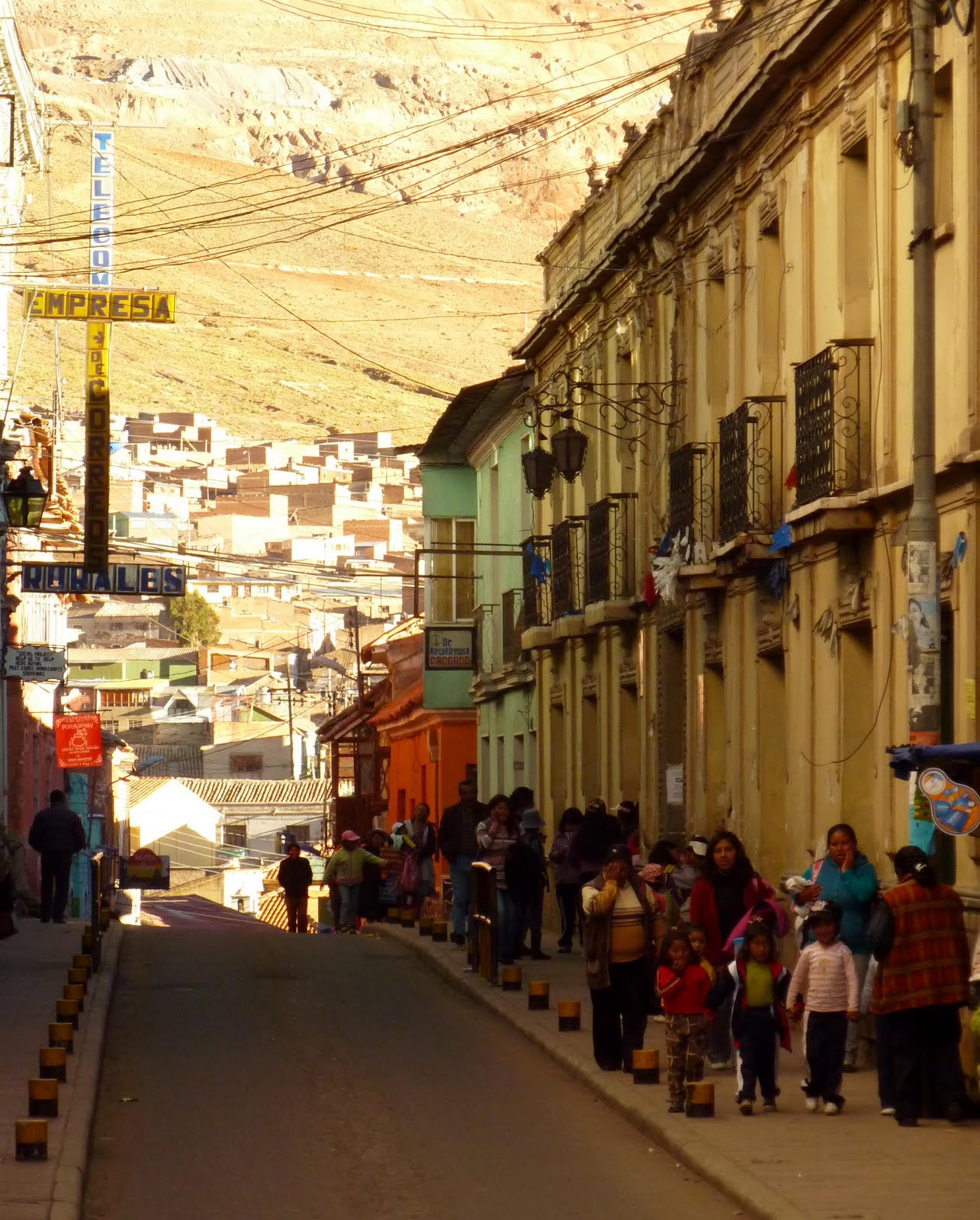
The Streets of Potosi.
At about six in the afternoon we arrived to Potosi, the third highest city in the world. With more than 4000 meters above sea level, Potosi leaves you breathless when you take on a challenge to climb its streets. Potosi’s alleys, no more than 3m wide that zigzag through the labyrinthine of the city confusing tourists, lead us into a different world. Grand wooden portals, giant stone walls. and lots of colors in the costumes of the local women give the place a mixture of history with today's miserable reality.

Potosi -once the richest city in Latin America.
It is amazing how this city, once the richest in Latin America, can barely afford to maintain a collection of its ancient crumbling buildings, which have not seen any advances besides deterioration. It is enough to just go out to the streets to find evidence of the importance and the wealth of the city, build on the bloody money of its rich silver mines. We visited one of these active mines in a company of our guide Reinaldo, an ex-miner himself, who now dedicates his time to showing tourists the horrifying conditions of a miner world. It was soul-chilling to see that deep inside Cerro Rico nothing changed, time did not advance and did not bring any progress to make working conditions bearable.

We entered through the mines of Rosario, within the famous Cerro Rico. At the altitude of 4500 meters above sea level, the tunnels inside the mountain are flooded by water that seeps through its walls, and the rails for the mining cars that transport the minerals are barely held in place by a few metal hooks. In the areas of possible caving in, the walls of the tunnels are held up by wooden arches, although more than once we have seen those beams broken in halve right above our heads, waiting for the last push to rush to the floor.

A Potosina.
Since the founding of Potosi in 1545, the Spaniards have been sending all of “the fruits of the mines” directly to Europe, but since not so long ago many mines are now run by mining cooperatives. Each one owns one side of a tunnel the benefits of which go directly to the mining partners. Nonetheless, it is not that easy to become a partner of a cooperative. First, for some 8-10 years you must work as a miner in the lowest category and gain experience, then, if you have saved enough money, buy one of the faces of the tunnel and only then begin exploiting it for your benefit. Predictable enough though, the gains in those mines are minimal and the conditions ... as well. We went down 3 levels (separated from each other by 50 meters of mineral), and the heat became almost unbearable. The air was scarce and mixed with gases from explosions making it very difficult to breathe. It seemed that dust was constantly accumulating in our throats, as we were constantly coughing and spitting, although without actually spitting anything out. This is the sensation that you get when breathing in sulfur, lead and hundreds of sulfates that invade your lungs. I can still taste and smell that awful concoction, and it has been about 5 weeks since our visit to the mines.

A mineral separation plant.
We reached an area where a group of people was working. It was a family of a father and two sons (it is very common to have a family cooperative), and we spoke to them for a while about their life as miners.

- How long have you been working in the mine? – I ask one of the sons.
- Since I was 12. -  He answered firmly, demonstrating that he was an experienced miner.

- And how old are you? - Asked intrigued.
- 24!

Since the age of twelve, for more than 6 hours per day, he was immersed in the inhuman reality of the underworld with no lights, no air, and no water. I could not comprehend this….. And even less I could grasp how this life was possible after I was explained how the minerals were extracted and transported to the surface. In some cases the actual mining is carried out with dynamite explosions, in others by a pneumatic hammer, but in 90% of the time the digging is done manually. It turns out, that in a cooperative everyone has to buy their own tools and materials, as well as dynamite and air for the compressors, which ends up being too expensive for the miners. The carts that transport the rocks are also pushed by hand, and in many cases the tunnels have no rails, or belong to a different cooperative, so to avoid paying for their use, the miners prefer to load 100 kilogram bags full of minerals onto their backs and transport them that way. 

We left the mines in disbelief, not understanding how it is possible to work this way. Being a cooperative and working as partners, how is it possible not to use at least some type of machinery to facilitate the process?! It was pointless to look for answers or solutions.

Minors' Quarters.
After the mine we went to a plant where minerals are cleaned and separated. Trucks full of rocks extracted from Cerro Rico deposit their cargo on a rotating drum which grinds the stones, transforming then practically into dust. Then, the dust goes through a series of chemical pools, and eventually silver particles begin floating on the surface, which are then driven by a rotating blade to other pools located outside of the building. The rest is easy. The water with the silver particles is deposited onto the floor, letting the sun evaporate the water. Then the dry silver sand is shoveled into bags for subsequent transport.

And what happens then? Where does that silver go to be melted and turned into different products? Europe. Asking these questions cleared everything. Cooperatives sell 8 tons of raw mineral (a truck-full) to the separation plants for just $500. Those, in turn, for just a little bit more, sell the pure silver powder to Europe. It is there where the silver is melted, turned into merchandise, and then exported around the world. Now, it is clear where the principal revenue ends up, isn’t it? Do you know how much a silver bracelet costs? Well, after this experience you will not want to buy anything made out of this filthy, disgusting material. However, as I think about it this way, we would leave 85% of Potosí out of work.


The Silver Sand.
It makes me so angry that after so much struggle to be able to form cooperatives and work freely, the miners continue working in the same conditions as hundreds of years ago, continue to die from the same diseases, continue to live in poverty, and the money continues to stay in the same hands. The only difference is that now potosinos do not feel exploited. But how do you explain to these people that they are being exploited as slaves for the benefit of others, if since the age of 12 they are immersed in this surreal underworld of false wealth, without any possibility to study to be able to understand that they are being manipulated?

These are the feelings with which we left Potosi and its mines. The mines, where even women worked for three years while Bolivia was at war with Paraguay and there were not enough men to do the work. The mines where workers drink pure 96% alcohol to survive the suffocating underground enclosure. The mines where people do not last longer than 40 years. The mines where, unknowingly, potosinos are exploited since childhood, deceived by the fact that now they work for their own benefit. The mines that provoke nothing else than shame, disgust and sadness.


Translated from the original post " Un Cerro Rico, No Tan Rico" by Emiliano Garcia.

27 may 2011

UN CERRO RICO NO TAN RICO

Panoramica de Potosi
Cerca de las seis de la tarde llegamos a Potosí, la tercer ciudad más alta del mundo. Con sus más de 4000 m.s.n.m., Potosí deja sin aliento a cuanto gringo ose por trepar sus calles. Enormes portales de madera remachada, gigantescos muros de piedra e infinidad de colores en las vestimentas de sus mujeres, otorgan al lugar una mixtura de historia con actualidad difícil de explicar. Callejones de no más de 3mts de ancho zigzaguean por la ciudad trazando laberintos que no hacen más que confundir a los turistas, aunque su solo transito ya nos introduce en un mundo diferente, sin importar demasiado a donde nos termine depositando.

Calles de Potosi
Nos acomodamos en lo que creo debe ser uno de los peores 3 o 4 hostales de Potosí; el hostal La Paz. Lo único bueno era la ubicación y que las habitaciones eran privadas, porque el aspecto de sus patios, el continuo llanto de niños y el insoportable olor a humedad mezclado con insecticida hacían dudar si los $Bs 25 que pagamos no serian mucho para lo complicada que se veía venir la noche. Los revoques de las paredes se caían con el sonido de los pasos sobre los pisos de madera deteriorados, y la cama con una mesita de madera a modo de escritorio a su lado me daba la sensación de que alguna vez un San Martin o algún Simón Bolívar habían escrito alguna que otra carta informando sobre sus movimientos de guerra.

Es increíble como esta ciudad que supo ser la más rica de toda América Latina, hoy apenas mantiene en pie sus antiguos edificios, sin ningún tipo de avance más que el del deterioro. Alcanza con sacar los autos de sus calles para retroceder cientos de años y colocarse entre colonizadores peleando por sus riquísimas minas de plata. Minas que visitamos para darnos cuenta que dentro de ellas, el tiempo realmente nunca avanzo, nunca trajo consigo ningún avance para hacer el trabajo más saludable, nunca le devolvió a los potosinos la riqueza que alguna vez ostentaban sus calles.

Mujeres Potosinas
Ingresamos por las minas del Rosario, dentro del famosísimo Cerro Rico. A más de 4500 m.s.n.m. los túneles dentro de la montaña se encuentran inundados de agua por las filtraciones de sus paredes y los rieles para los carros que sacan el mineral apenas si se sostienen con algunos ganchos. En las zonas donde el túnel es factible de un derrumbe, arcos de madera son emplazados para sostener las rocas, aunque en más de una ocasión observamos por sobre nuestras cabezas maderas quebradas esperando un mínimo empuje para precipitarse al suelo.

Callejones
Desde su fundación en el año 1545 los españoles obtenían todo el fruto de los minerales el cual era llevado directamente a Europa, pero de un tiempo hasta parte, las minas se convirtieron en cooperativas por lo que hay quienes son dueños de una cara del túnel y todos los beneficios que esta les brinde pasan directamente a el minero socio y sus súbditos. Aunque no es tan fácil llegar a ser socio. Primero se debe ser minero de la más baja categoría, adquirir experiencia, y con el paso de al menos unos 8 a 10 años, juntar el dinero para comprar una de las caras y comenzar a explotarla para su beneficio. Pero muy a pesar de lo que parece, las ganancias son mínimas y las condiciones… también. Descendimos 3 niveles (separados entre ellos por 50mts de roca), y el calor se torna casi insoportable. El aire escasea y mezclado con los gases de explosiones y movimiento del propio cerro hacen muy difícil respirar. Incluso parece como si juntásemos polvo en la garganta, por lo que estamos constantemente escupiendo, aunque no escupimos nada, ya que esta sensación es la que da el respirar azufre, plomo y cientos de sulfatos que invaden nuestros pulmones y los de quien ande por el lugar.

Mineros Inexpertos
Llegamos a una zona donde un grupo de personas estaban trabajando. Era una familia, con el padre y sus dos hijos (es muy común que se asocien entre familiares), y pudimos hablar un rato con ellos sobre inquietudes que teníamos.

- Y cuanto hace que trabajas en la mina? – pregunte a uno de los hijos.
- Ya 12 años – me respondió con firmeza demostrando ser un experimentado minero.
- Y cuantos años tenes? – pregunte intrigado.
- 24!

Desde los doce que estaba inmerso en ese mundo subterráneo por más de 6 horas por día, sin luz, sin aire, sin agua, en condiciones inhumanas. Mi cabeza no podía entenderlo. Y menos lo entendí luego de que me explicasen la manera en la cual extraen el mineral. En algunos casos realizan detonaciones con dinamita, en otros utilizan un percutor neumático, pero en el 90% de las veces el trabajo es a mano. Resulta que al ser cooperativas, cada uno debe comprar sus materiales y tanto la dinamita como el aire de los compresores les son caros para su trabajo. Incluso los carros para transportar las rocas son empujados a mano, y en varios casos los túneles no poseen rieles o bien se encuentran en un túnel el cual no les pertenece y por no pagar por su uso a otros socios, prefieren cargarlos en sus espaldas en bolsones de hasta 100kg.

Minero con uno de los Bolsones de 100kg
Salimos de las minas indignados, sin entender cómo se puede trabajar de esta forma. Siendo cooperativas y trabajando como socios, como no poder al menos utilizar algún tipo de maquinaria para facilitar los movimientos. Era en vano buscarle soluciones.

Nos dirigimos a un ingenio, una planta separadora de minerales. Allí llegan los camiones con las rocas extraídas del Cerro Rico, las cuales son depositadas en un tambor giratorio que muele las piedras hasta transformarlas prácticamente en polvo. Luego, estas van pasando por una serie de piletas, las cuales con el aditamento de ciertos químicos, hacen flotar las partículas de plata, las cuales son empujadas por unas palas giratorias hacia otras piletas que se encuentran en el exterior. Desde ahí lo que queda es más fácil. Se echa el agua con los minerales sobre el piso mismo, dejando que el sol evapore el agua y se carga la plata con pala en bolsones para su posterior transporte.

Carros para extraer los Minerales
Y a donde funden la plata y la trabajan para realizar diferentes productos? Esa simple pregunta respondió todo. En Europa. Las cooperativas venden 8tn de piedra en apenas USD 500 a los ingenios, los cuales luego de separar los minerales venden a poco más toda la plata en polvo a Europa. Son ellos quienes la funden, la utilizan en fabricación de diferentes productos y la exportan a todo el mundo. Está claro dónde queda el gordo de la ganancia no? Ustedes saben cuánto sale una pulserita de plata? Después de esto no dan ganas de comprar ninguna cosa que sea de este asqueroso material plateado. Aunque pensándolo diferente, dejaríamos sin trabajo al 85% de Potosí.

Ingenios
Da mucha bronca que luego de tanta lucha para que los mineros creen cooperativas, ahora que lo logran sigan trabajando en las mismas condiciones que cientos de años atrás, sigan muriendo de las mismas enfermedades, sigan viviendo en la misma pobreza, y que el dinero siga quedando en las mismas manos. La única diferencia es que los potosinos ahora no se sienten explotados. Pero como explicarle a esta gente que los utilizan como esclavos para el provecho de otros, si desde los 12 años se ven inmersos en este sub-mundo irreal de riqueza, sin posibilidad de estudio para comprender que están siendo manipulados?

Cerro Rico
De esta manera dejamos Potosí y sus minas. Minas donde incluso trabajaron mujeres durante tres años mientras Bolivia estaba en guerra con el Paraguay y no había hombres para explotarlas. Minas insalubres donde sus obreros toman alcohol puro a 96 grados para soportar el encierro. Minas donde la gente no supera los 40 años de edad. Minas donde sin saberlo, son explotados desde niños todos los potosinos, engañados con que ahora trabajan para su propio beneficio. Minas asquerosas… minas de mierda…