The night before leaving Bolivia to cross into Brazilian territory Emi was very nervous and anxious. Continuously, he repeated that he wished there were other tourists crossing the Brazil border the next day. In Argentina, Brazil has a fame of being unsafe and even violent especially to tourists. It comes from the animosity between the two countries and also the occasional news about Argentine vacationers being robed or even assaulted in Rio or Sao Paulo during the tourist season. It also did not help to see posters on every corner of Guayaramerim (the Bolivian border town where we were) announcing a monetary prize in exchange for information about a young French couple which disappeared around that area in August of 2010. Emi was convinced that if we found more travelers to join us, it would be much safer to travel in a group through that part of the world. We didn’t exactly go looking for more people, but somehow travelling through the Amazon in a group was in our destiny.
Short distance river transportation.
Mauricio appeared out of nowhere at the money exchange post when Emi, in his porteño manner, was loudly expressing his frustration about something. Argentino?! – exclaimedMauricio. He was just as happy to find us as we were to find him. At least Emi and I had each other, and Mauricio’s only company was his bicycle Rosa, which he ended up donating the following day. An hour into meeting Mauricio he told us that he was not really a cyclist, and travelling by bike was an impulsive last minute decision. He said that because of one reason or the other he was not able to bike as much, and often he had to travel by bus paying extra for Rosa’s place in the baggage compartment.
Casa de la Cultura museum in Manaus.
When he heard that in the Brazilian Amazon it was dangerous to be on a bike by himself he was done with it. The bike went to the next nice person we met, who happened to be Sr. Pimienta, an ex senator candidate at the local municipal administration, and the owner of the hostel where we stayed. Mauri was like this with everything. He travelled with the flow (almost literally) and made decisions on the spot when things came up. Surprisingly enough, we learned that just a few months before our encounter, Mauri was an owner of a mid-size agro-enterprise, raising cattle and managing acres and acres of land. As soon as Mauricio graduated from college he put his agro-engineering degree to practice in the endless grazing fields of the Argentine province of Santa Fe. Nevertheless, wealth and professional success did not make him happy, and at the age of 40 he sold everything and set off to explore the world. Mauricio became our friend and companion for almost a week with whom we not only crossed the Bolivia-Brazil border, but also took a bus to Puerto Velho, travelled by boat to Manaus and even went to see Jazz at the grand Teatro Amazonas.
These guys look for gold in the Amazonas.
Our first night in Brazil was a pleasant surprise. We arrived to Porto Velho as it was getting dark. The city did not strike us as safe and cozy, so we decided to find a place to stay close to the terminal and wait till morning to go explore. Despite a questionable appearance of the front façade of the hostel that we found, for only 10$ a person it offered newly renovated rooms with a private bathroom, TV, a mini-fridge and an AC!!! After a day of wandering in a 100% humidity and 100 degree weather with a 16 kilo backpack behind your shoulders an air-conditioned room feels like heaven!
The modern day "garden city" huts.
The next day we marched to the port to find a boat that would take us to the heart of the Amazon – Manaus. We did find it, but not after doing some rounds around the city trying to follow directions to locate a bank and an internet cafe. We found out that asking for directions in Brazil is pointless. In that country people would send you places without knowing where those places are without any problem. They would never say “sorry, I don’t know”. It is just unacceptable there. After a while we decided to rely on maps, our intuition, or at worst ask three different people to compare the answers. With the boat schedules it was a similar story. We were never told the actual day and time of the departure. You’d probably ask - “How do you know when the boats leaves to make it?” Well, schedules exist, but they are not really observed and boats leave according to how quickly cargo is loaded. Of course, all of this we did not find out until a couple of boat trips in. The boat we boarded in Porto Velho did not leave until the following day and we spent our first night on the water in a boat docked at the port.
Teatro Amazonas in Manaus.
The boat ride from Porto Velho to Manaus was great. For me it was like a three day cruise with everything included. I spent hours watching pink river dolphins play in the water as they followed along side of our boat. I loved hanging out on the upper deck or in my hammock, talking to our new friends, making earrings (I even sold 2 pairs!) or writing. Mauricio was always up for a conversation or some refreshing terere (yerba mate with juice) that we shared with another Argentine (a park ranger from one of the national parks of the Tucuman province). If the Argentines were not there, my Brazilian hammock neighbors were always excited to teach me new words, or laugh at me when I did not understand what they were saying. The meals (3 times a day) were homemade and really tasty, and one day we even got a churrasco (a Brazilian BBQ) in between the meals. The Brazilian BBQ is something special….It turned out, they do not use any plates or cutlery, or any manners when it comes to meat. If you want some meat you have to get it right from the knife of the person cutting the stakes. It was quite hilarious how you had to fight for your piece of meat, however, at the same time it was not exactly funny because the guy could easily cut off your fingers at any moment.
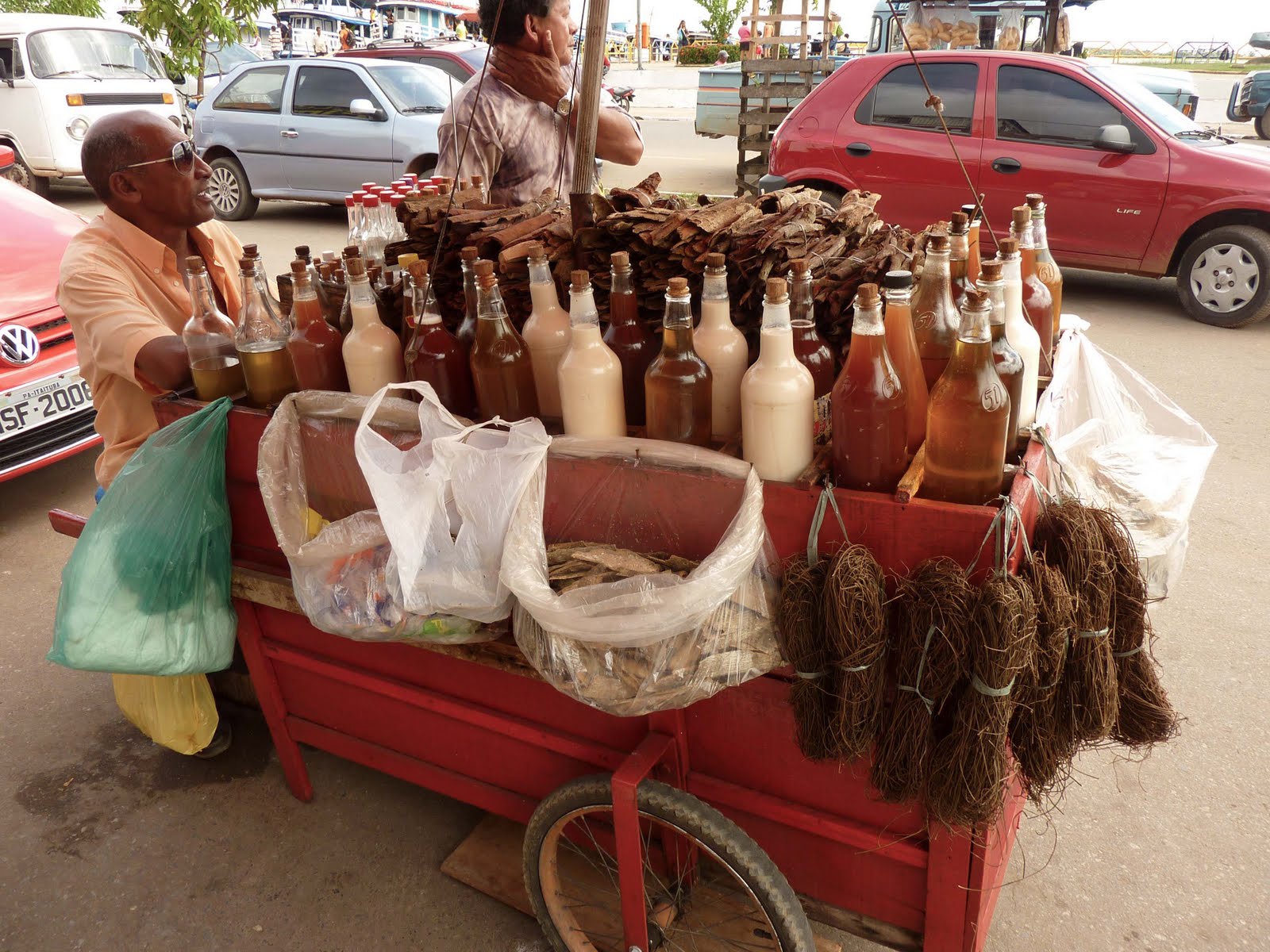
A local pharmacy...
In between the meals and especially in the early hours of the first part of the day before it got unbearably hot we spent time on the upper open deck of the boat enjoying the view and chatting with the fellow boat travelers. One of them was a German scientist travelling to the middle of the Amazon (now for the 3d time) to study the way ancient inhabitants organized their cities and how they managed their waste water. He was an agro-engineer, who now worked for a water management company in Hamburg, and his role was to come up with new ways to manage waist and waste water. As they say, “anything new is a well forgotten old”, so he went to the Amazon to dig up this once forgotten old. It was very interesting to learn that the river backs of the Amazon with its poor sandy soil used to host greatly populated “garden cities” which were self sufficient, sustainable and thriving. I’m not sure what lead to their destruction, but there are certainly none of those lush communities left, and what you see are barely standing wooden huts on stilts. The same scientist also told me that there used to be a city called Fordlandia, located a few miles down from Manaus. And yes, Fordlandia comes from Henry Ford, who built the whole city with a sole ambition to harvest rubber trees for his automobile tire production. This whole tire business together with Fordlandia didn’t really work out, as around the same time the Brazilian rubber boom was over. In 1895 a number of caoutchouc trees were secretly taken to South East Asia (Singapore area), which by 1910 became the new main producer of rubber. We did not mange to visit what remains of Fordlandia, but I am sure it would have been quite a unique experience.
Brincos, brincos!!! Pulcerinhas! Baratinho!
After Manaus, where we spent a couple of days we took 2 more boats to reach Belem, one of the main cities on the northern coast of Brazil. Unfortunately, those 2 boats were not of the level of the first one, neither in conditions, nor in quality of service so we were really happy when we were finally in Belem. Even thought I liked the experience as a whole, I was a little disappointed that we did not see any of the exotic things that one imagines when talking about the Amazon. The main rivers are commercial travel routs with little possibility see lush tropical nature, or native tribes. From what I understand, the “exotic Amazon” is preserved in the Protected Areas, which are far and very difficult to get to. It is of course possible, but was completely out of our budget, as we would have had to go with a local guide, pay for additional transportation and accommodations. Crossing the Amazon was fun, but I feel like I have to return to experience the Amazon I could not afford this time.
The last 2 weeks of May we spent in Santa Cruz, resting at the house of Gustavo Garcia (Emi’s uncle), who moved from Buenos Aires to Bolivia some 13 years ago. The stay was very pleasant and relaxing, but quite uneventful, as we mostly stayed at the house and hung out with the kids (they have three). Gustavo’s wife Gaby made sure we weren’t hungry by preparing exceptional meals and all sorts of snacks for us 4 times a day. It was like staying at an all inclusive hotel, where everything is done for you, and you are constantly inquired if there is anything else that you might wish. In other words, Garcia-Santarosa’s hospitality was unbelievable! THANK YOU FOR EVERYTHING!
On Monday night, May 28th, it was time for us to hit the road once again. We debated for a long time which way we should travel to the Brazilian border and what method of transportation we should use. Our options included going through La Paz or through Trinidad by a combination of any of the following: bus, boat, plane and a cargo truck. We decided to go with the most economical and relatively quickest option, which was a bus.
"Country roads, take me home..."
I have taken busses long distance more than once, so a prospective of being on the bus for consecutive 38 hours did not scare me too much. The experience was not scary, but something I do not recommend doing unless you are travelling on pennies like us. Our first over night bus from Santa Cruz to Trinidad was not so bad. Emi made sure we got front row seats which allow for some leg space. As you know, you can’t really call me a tall person, but in Bolivia it is not true, so I had to think about leg space and things tall people usually worry about. I really don’t know how normal size gringos can fit into anything here, if I was having trouble with ceilings and seats. So that night we actually slept, but only until dawn when we were woken up by roosters’ morning songs. I was all confused and thought that the sound was produced by someone’s alarm clock or a cell phone. When the sounds did not stop for an hour of two, it was clear that some of the passengers on that bus were real live roosters. In Trinidad, this was confirmed. 6 “singing” cardboard boxed were unloaded from the back of the passenger deck of the bus. Thank God they were just rooster and not pigs this time.
River Crossing...
In Trinidad, we learned that the next bus to Guayaramerin was leaving within the following 2 hours and I we did not take it we’d have to wait 24 hour for the next one. Trinidad, with its open sewage canals, with accompanying aromas and dust, was not quite appealing to me…So there we were on a bus again. This time however, it was a special kind of a bus. The kind of bus that does only dirt road routs, and has been doing them since the 70s….You can only imagine how I felt boarding this vehicle in an anticipation of a 28-30 hour ride. They say that the same rout can take up to 4 days in the summer season!
So, here are some 5 things that most impressed me about this special Bolivian treat bus trip:
1.There were about 10 small children on board with us and they slept on the dusty dirty floor between the seats. When the bus stopped for us to take a pee in the bushes, or no bushes, everyone had to be very careful not to step on kids limbs when exiting and entering the bus.
2.At one point we had to cross a river about 30 meters wide, and there was not bridge. The bus and the passengers were sent to the other side on a wooden float moved by a small motorboat.
3.When there were rest stops, most passengers bought food, candy, fruit and drinks to take on the bus. Naturally, all of this trash was soon on the floor, so you never knew what you were going to find under your foot in the middle of the night.
4.In the morning, I, once again, discovered that buses are very animal friendly in Bolivia. A few rows in front f me there was a woman travelling with a dog.
5.One of the passengers, whom Emi made friends with, told us that he was a hunter, and that he was travelling to the tropical part of Bolivia to stay there to hunt until December. Among his hunter stories, he told us that he had his rifle with him on the bus, and wanted to take it out to show it to us. I am sure it was a great gun, but I have had enough on that bus without adding more excitement to it.
Bolivian Ferries.
Oh, and one more thing. When we were all finally out of that bus, people looked like they were coming from some field exercise where they dug trenches. Everyone’s clothes and luggage were brownish-red, completely covered with the dirt road dust.
By 2pm on June 1st we were in Guayaramerin, a border town with Brazil. I could hardly believe that this was our last stop and we did not have to get back on that stupid bus…. We made it! Thank you, God!!!
Por la mañana, luego de unas 10 horas de viaje despertamos en Trinidad, con el canto de unos gallos que llevaban dentro del micro mismo. Todavía bastante melancólico y triste por haber dejado Santa Cruz, comencé a averiguar las diferentes maneras que teníamos para llegar a Guayaramerin, ciudad frontera entre Bolivia y Brasil, y los métodos aunque parezca mentira, eran varios. La opción más rápida, pero también más cara y por ende descartada era el avión. Otra manera era en barcos cargueros que bajan por el rio Mamore hasta la frontera misma, pero para esto debíamos gastar cinco días, y al saber que ya navegaríamos en Brasil, era mucho tiempo, por lo que también fue descartada. Por último teníamos la flota; los buses bolivianos. Lo único que no estaba muy en claro era el tiempo que estos demoraban, ya que ante mi interrogatoria, recibí respuestas de lo más variadas; “24hs”, “36hs”, “2 días”; en fin, sería un viaje muy muy largo.
Rio Mamore
En apenas unas horas salía la flota, y no tenía sentido esperar al día siguiente, por lo que sacamos nuestros boletos y nos montamos en el bus más viejo, sucio, y rotoso que subí en mi vida, el de la empresa 1ero de Mayo. Era de los años 70, color crema con una franja roja, con butacas enfundadas llenas de polvo y caños a modo de columnas para sostener el techo. En las bauleras no solo llevábamos equipaje, sino también unas 20 garrafas de gas de 10kg; una bomba en movimiento. El chofer conducía sobre un asiento de hilos de goma y maniobraba un volante al cual solo le quedaba el hierro del interior oxidado. Sobre su cabeza, se improvisaba una litera con unos caños soldados y un pedazo de espuma a modo de colchón. Los buches sobre los asientos apenas se sostenían con alambres y algunas sogas, y el baño… bueno, no había baño.
Camiones cruzando el Mamore
Comenzamos a movernos, la odisea comenzaba. Luego de un primer tramo, en el cual todavía nos sentimos bien, donde nos parece que exageramos al prever tan duro viaje, llegamos al rio Mamore, el cual debe ser cruzado en balsa ya que es bastante ancho y si aquí no hay carreteras; menos hay puentes. Una embarcación de madera llena de filtraciones, comandada por un pequeño bote a motor nos cruza tanto a nosotros como al bus. Ya del otro lado continuamos viaje y entre pampas y selvas, atravesando todo el departamento del Beni, la zona agrícola ganadera de Bolivia, se nos hizo la noche.
Nuestra flota cruzando el Mamore
Era imposible dormir en esas condiciones. Entraba tierra por las ventanas, la incomodidad era absoluta y por si fuera poco hacia un calor insoportable. Paramos a cenar y para ir al baño, y el alivio al salir del encierro era enorme. Pero en pocos minutos volvimos al bus y las condiciones volvieron a lo primitivo nuevamente. Si viajar en la zona del altiplano es una odisea, esto no sabría con que adjetivos catalogarlo. El pasillo estaba lleno de niños y gente, y como si el bus no estuviese completo, cerca de las 3 de la madrugada se detuvo en un diminuto pueblo (Santa Rosa de Yacuma) y subió aun más gente, la cual no tenía otro remedio que viajar parada o tirada como pueda por algún rincón del micro. No sé cómo pero paso la noche y esperábamos que el llegar a destino no pasase del mediodía.
Paisaje del Beni
Pero el andar parecía interminable. El camino ahora es de tierra colorada, y el paisaje similar al de Misiones en Argentina solo que completamente llano. Grandes montes selváticos se extienden a nuestro alrededor y grandes nubes de polvo en el interior del bus. Para intentar pasar un poco más rápido el tiempo me pongo a charlar con quien se sentaba detrás mío. Un hombre de unos 35 años, de tez morena y cabeza rapada. Un fino bigote bajo su pequeña nariz, era como la continuación de una gran cicatriz en la mejilla, de la cual no me anime a preguntar su procedencia. Me contaba que venía a Riberalta a cazar, y que incluso tenía su rifle ahí, en los buches del bus sobre su cabeza. Un poco anonadado no entendía que viajara en el bus con el rifle encima, como si se tratase de una guitarra.
Lanchas que cruzan al Brasil
Me levante para pedir al chofer que se detenga para ir al baño y note que una de las pasajeras viajaba con un perro entre las piernas. La gente bajaba a orinar y se les notaba un aire de guerra, un aspecto de haberse revolcado entre el polvo durante horas sin tener siquiera un poco de agua para lavarse ni las caras. Cuando parecía que nunca llegaríamos, vi por la ventana la publicidad de un partido político, con la cara de un postulante a alcalde; de alcalde en Guayaramerin. Creo que no vi en todo el trayecto un solo cartel de publicidad, pero la política llega incluso a donde no llega ni siquiera Coca-Cola. Pero lo bueno del cartel era que si o si, debíamos estar cerca de destino. Luego de unos 15 minutos llegamos a la terminal.
Lanchas esprando su turno
Me sentía como si hubiese ganado una batalla muy dura, donde había recibido más golpes de los que había dado. Una batalla de 29 horas entre el polvo, la incomodidad, los malos olores y el malhumor absoluto; pero la habíamos ganado. Estábamos ya en Guayaramerin, prontos para ultimar los últimos detalles antes de cruzar definitivamente a Brasil y adentrarnos por completo en la inmensurable selva Amazónica.