
 |
| Somewhere in the middle of another desert. |
Bolivian south is very similar to the north of Argentina in its nature, traditions and even ethnic population, so I didn't feel a strong difference when we were finally on the Bolivian side. The one thing that did strike me was the border itself. There are three different gateways through which one can get to the other side: one is through the immigration office, the other avoiding it (it is up to you to register, and enter the country legally), and the third one is through the walking contraband bridge.
 |
| "Contrabando de hormigas". |
It is a shocking scene to observe hundreds of people (many women and mostly indigenous) rapidly shuffling across the bridge with cargo twice their weight tied onto their backs. They carry goods from the Argentine side to the Bolivian side as fast as they can, then run back to the Argentine border to repeat it all over again. These people are contracted for a meager pay per trip to transport merchandise on their backs so that the owners of the cargo don’t have to pay foreign taxes. There is a law, according to which you can bring as many goods into the country as you can physically carry. So, this is the loop hole that is used and abused right in front of the customs officials 24/7! Hundreds of trucks arrive to the boarder daily, unload their cargo, send it to the other side on people’s backs, and load it back up to then continue the trip. It is obvious that these kinds of things happen on every border in Latin America, but seeing it with your own eyes shocks…
 |
| Salt and more salt...at teh Salar de Uyuni. |
Anyways, having crossed the border (choosing the immigration office option) we were in Villazon, Bolivia. As Villazon turned out to be a typical border town with dusty streets and shabby looking constrictions, we decided to get on the first available train to the mythical Salar de Uyuni (12 hours away).
The Salar de Uyuni is the largest salt flat in the world covering 10,582 square kilometers. About 40,000 years ago this salar was covered by a prehistoric lake Minchin. When it eventually dried out it became an endless white salt desert, which supposedly grows larger and deeper with every year. According to our guide Juan, in the deepest part of the desert, the layer of salt reaches down to 14 meters (20 meters according to Wikipedia). Salar de Uyuni is located in the Oruro and Potosi departments of the country, which are a part of the Bolivia Altiplano or high plateau, a part of the country with very little population and unbelievable natural beauty. The Salar de Uyuni is surrounded by a number of other deserts, which in their turn are surrounded by mountains with peaks above 4,000 meters.
 |
| Surreal! |
I have never heard about this place until I met Emi, whose Facebook profile photo was taken in the Salar de Uyuni. Apparently, this natural wonderland is becoming popular at the speed of geometrical proportion. Ten years ago this salar received about 9,000 visitors, and now this number is up to 70,000. Even though the place is becoming more and more touristy, and there are gringos from all over the world on every corner in the village of Uyuni, this adventure excursion doesn’t lose its attraction. If you are looking to see some mind blowing landscapes, have some Latin American adventure on a limited budget, and disconnect from the modern developed world you must come to the Bolivian Altiplano. You will have something to remember!
 |
| This world is amazing! |
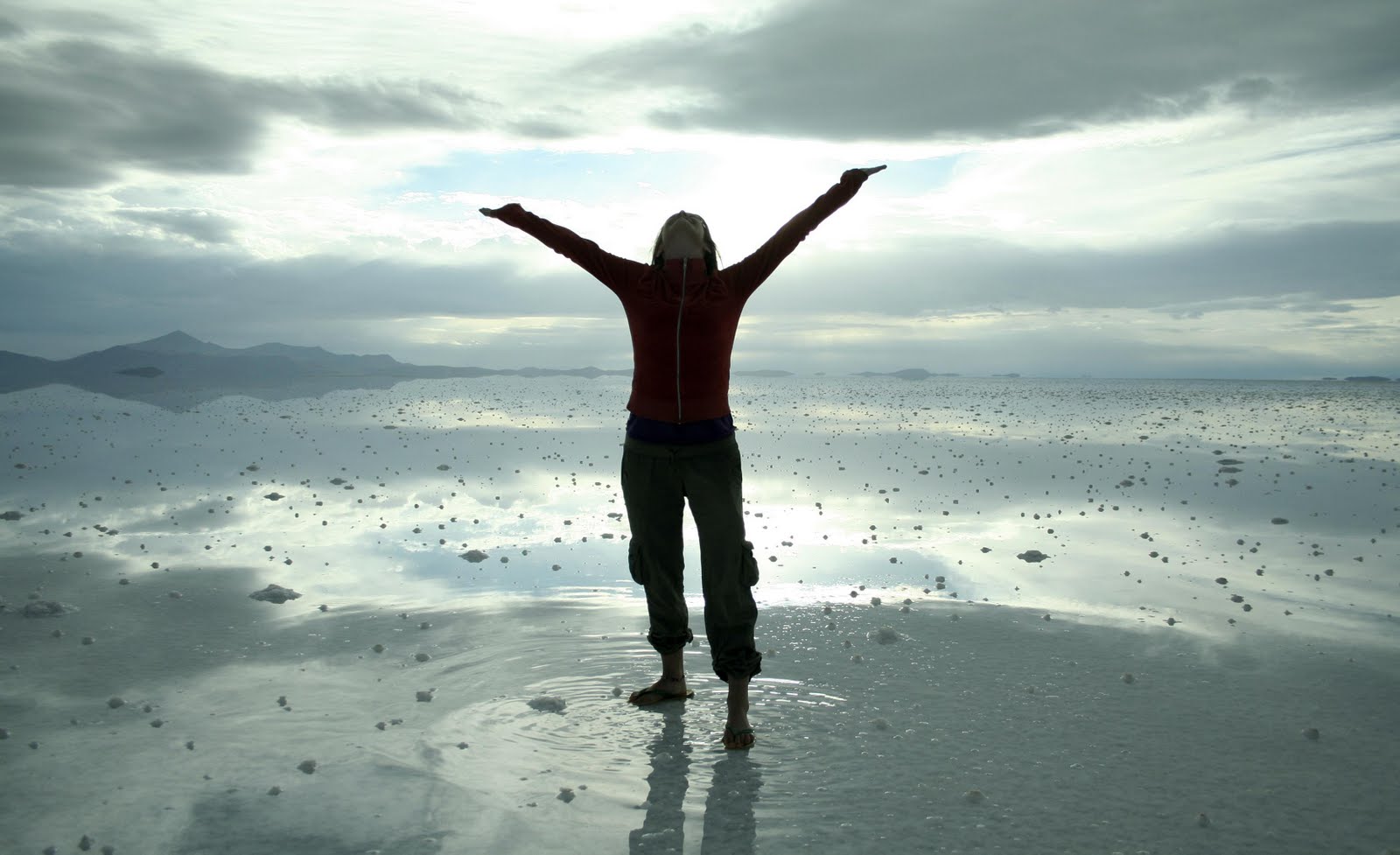
From all of the places I have been to in the world so far, this was the most different and breathtaking place I have seen. With a little bit of water on the surface, the salt transforms into a perfect mirror reflecting the sky. The sensation is absolutely surreal when you feel as if you are floating in the clouds, as you can’t tell where the earth ends and the sky begins. Looking through the windshield of our SUV I saw no horizon, and it felt as if we were driving directly into the clouds!
 |
| Just another lunch spot... |
As most other seas, this sea also has islands above its surface. We stopped for lunch at one of them, Incahuasi or the Fish Island, during our first day of the trip. The coral island covered by enormous cacti (some 1000 years old) is not only gorgeous by itself, but also offers a panoramic 360% view of the whole salar. I felt as if I was on another planet, or in some parallel reality where laws of physics did not apply. Looking all around I felt as if I was surrounded by a never ending ocean, but somehow it was white and solid. What also blew my mind in that virtual world, was that I could not trust my eyes. When we were on the way to the Fish Island, I asked how far it was, expecting to hear that it was no farther than 10 minutes away (it looked like we were right next to it). The reply was that it was some 50 kilometers away, which took us about 40 minutes to cover. It felt as if the perfect white planes around played tricks on us. Somehow, everything appeared to be much closer, and moved much faster as it did in reality. It was INSANELY SURREAL…..!
 |
| Parallel worlds. |
This time around, as we did not have our own transportation, and no funds to rent any, we joined a group of other 4 travelers and a local guide to take us to the salar and through the deserts of the Altiplano. It is absolutely worth doing it this way. You pay about $100 for 3 days of travel (close to 1000 km.) + all meals + lodging + a guide/driver! Nonetheless, we decided that the next time we do it (we are determined to return one day), we do it our own way and at our speed, stopping where we want, and staying the places we like for as long as we want. There were so many incredible spots where we wanted to stay and soak in the quiet beauty and peace, but we only had 3 days and a 1000 km to cover…
 |
| The train to nowhere. |
The first day of the trip we spent crossing the salt desert. We left the town of Uyuni at about 9 am and had our first stop about 30 minutes later on the town outskirts at the steam train cemetery. The iron ruins of these once impressive machines are quite picturesque and are great for photo projects. Other than that, it is actually quite a sad seen, exhibiting little respect for the environment with trash of all sorts spread out in all directions. Garbage, and especially plastic waste is something that never stops shocking me wherever I go. Beverages and other products in plastic containers took over the world a long time ago, but it really feels like an invasion on the environment when you see those millions of plastic bags and bottles all over the ground in the developing countries…
 |
| Almost flying... |
Why isn’t there a regulation for ANY-KIND-OF-COLA to build a plastic recycling plant for every soda plant that exists?! Besides, before selling their plastic crap, they should prepare the local population by educating them that plastic does not rot and decompose if you throw it on the ground, like they do with vegetable and animal waste. It takes 450-1000 years for a plastic bottle to break down , and about 500 years for a plastic bag (not even decompose)!!! Apparently, humans have never been environmentally conscious and always tossed they waste wherever they fancied. Well, it was not a big deal until it was all biodegradable…
 |
| A place to meditate and levitate. |
By the end of our first day of the trip we reached the part of the salar which was still covered with water from the rainy season. Looking out of the window it felt that we were on a boat navigating and not driving in a car, especially when the water got deeper and we could hear the wake waves splashing as we passed. We were especially lucky to reach this part of the salar right when the sun was getting ready to set behind the horizon. The scenes we saw that night were impossible to describe… I can only say that it was probably the most memorable sunset I have seen in my life.
 |
| The "Rock Tree". |
That night we were pleasantly surprised by our accommodations. We were supposed to stay in a group hostel, but because we reached it later that other travelers, it was full and we had to drive an extra hour to another village, where we were placed in one of the salt hotels. Not only that we had our own individual rooms, but we also actually had an opportunity to stay at a hotel completely made out of salt. Everything, from floors to beds and tables was made out of pure salt. It was especially fun to find all this salt useful at dinner time when I needed to spice up my food.
 |
| The "Red Lagoon". |
The next day turned out to be a special day of adventure for Emi. In the morning, after about an hour of driving, our guide Juan confessed to us (only Emi and I could understand, as the rest did not speak Spanish) that he almost did not slep the night before and was not feeling too well. He told us that one of his relatives died in a mining accident that night, and so between the sorrow and the alcohol he almost did not catch a wink. We did not know whether to believe the story or not, but the part about being tired and hung over was true for sure, so very quickly it as decided to replace Juan with Emi as a driver. It was all fun and exciting, the only thing is that in some places there were no roads and we drove right in the middle of an open desert not knowing if we were going the right direction or not. Every so often Emi woke Juan up to check about directions, but every time the semi sleepy gesture directed us to go straight… We had to trust what he sad and continue towards the horizon. According to some rumors, a number of people got lost and died in those deserts trying to establish records by crossing them on foot. We were not on foot, but were still quite worried about getting lost. We had no GPS, maps were useless in places where there were no marked roads, and compasses do not work there (because of the magnetic minerals in the ground).
 |
| Flamingos. |
By lunch time, after some hours of R&R, Juan was back on. Shockingly, we ended up at one of the lagoons we were told we were going to see. It was overcast that day and we thought that we were not going to be able to take photographs that do justice to the place. Nonetheless, by the time we reached the lagoon, the overcast turned into grayish-white dramatic cotton balls that sat on the mountain peaks. It was so beautiful that I wanted to run around, jump and scream to feel that it was real and I was not dreaming. And so I did! It was really fun and somehow liberating.
 |
| Salt roads. |
In the afternoon there were more deserts, more lagoons and another sunset. I really have no words left to describe what we saw. You should just come and see it for yourself! That night our sleeping arrangements were a bit different and we all had to sleep in a dormitory with a straw ceiling. I had no problem with any of this, but our German companions freaked out and wanted to have Juan find as a different place. They read in their guide book that these straw roofs can sometimes have these insects “vinchucas”, and if bitten, you become sick with this lethal disease “chagas” which has no cure. It is true that this danger exists, but since all of the 70,000 tourists sleep in these places somehow it must be safe. Besides, there wasn´t much of a choice of hotels in the middle of a desert! Oh, those Germans!
 |
| Hot springs. |
The next day, all safe and sound, first thing in the morning we went to take a dip in some hot springs. I was excited to finally experience hot springs as they come in nature. The place had a little shack/changing room, and nothing else except for a steaming hot beautiful lagoon surrounded by far away mountains. We played in the healing hot waters until Juan dragged us out, and packed us back into his car. We didn’t have much time because we had to get to the Chilean border to drop off Linda, one of the Swiss members of our crew. There, we learned that dropping someone off did not mean that we got to travel back to Uyuni (500 km) in more comfort. Very quickly Linda was replaced with 3, not exactly little, guys from England and Israel. With 8 of us in this “have seen it all” TOYOSA (Santa Cruz type of Toyota) ´96 SUV we started to head back.
 |
| Time to go back... |
The one stop that impressed me that day was at the Red Lagoon. The water in that lagoon was really red! It is that color because of the algae that do photosynthesis in a particular way that turns them redish. It is quite strange to see red water, but it was not the water that made me want to stay there for much longer. Deep inside the lagoon there are hundreds and hundreds of pink flamingoes, which slowly walked in the water looking for the best place to feed. There are three kinds of South American flamingos: the Chilean, Andean and rare James's Flamingos. There are very few species left of these birds, the natural habitat of which is being continuously threatened by human activity.
 |
| Something is wrong with the horizon! |
The places where we travelled in those tree days were not all protected lands, and only a part of these deserts is within a national park, but the rest can be cultivated, excavated and exploited in any other way. This whole part of Bolivia should be a protected area! That place is really a world treasure which will disappear unless something is done…
A number of hours later we were back in the village of Uyuni. It felt strange and abrupt to be back in “civilization”. I did not get enough of those deserts this time, so will have to come back…


