The last 2 weeks of May we spent in Santa Cruz, resting at the house of Gustavo Garcia (Emi’s uncle), who moved from Buenos Aires to Bolivia some 13 years ago. The stay was very pleasant and relaxing, but quite uneventful, as we mostly stayed at the house and hung out with the kids (they have three). Gustavo’s wife Gaby made sure we weren’t hungry by preparing exceptional meals and all sorts of snacks for us 4 times a day. It was like staying at an all inclusive hotel, where everything is done for you, and you are constantly inquired if there is anything else that you might wish. In other words, Garcia-Santarosa’s hospitality was unbelievable! THANK YOU FOR EVERYTHING!
On Monday night, May 28th, it was time for us to hit the road once again. We debated for a long time which way we should travel to the Brazilian border and what method of transportation we should use. Our options included going through La Paz or through Trinidad by a combination of any of the following: bus, boat, plane and a cargo truck. We decided to go with the most economical and relatively quickest option, which was a bus.
"Country roads, take me home..."
I have taken busses long distance more than once, so a prospective of being on the bus for consecutive 38 hours did not scare me too much. The experience was not scary, but something I do not recommend doing unless you are travelling on pennies like us. Our first over night bus from Santa Cruz to Trinidad was not so bad. Emi made sure we got front row seats which allow for some leg space. As you know, you can’t really call me a tall person, but in Bolivia it is not true, so I had to think about leg space and things tall people usually worry about. I really don’t know how normal size gringos can fit into anything here, if I was having trouble with ceilings and seats. So that night we actually slept, but only until dawn when we were woken up by roosters’ morning songs. I was all confused and thought that the sound was produced by someone’s alarm clock or a cell phone. When the sounds did not stop for an hour of two, it was clear that some of the passengers on that bus were real live roosters. In Trinidad, this was confirmed. 6 “singing” cardboard boxed were unloaded from the back of the passenger deck of the bus. Thank God they were just rooster and not pigs this time.
River Crossing...
In Trinidad, we learned that the next bus to Guayaramerin was leaving within the following 2 hours and I we did not take it we’d have to wait 24 hour for the next one. Trinidad, with its open sewage canals, with accompanying aromas and dust, was not quite appealing to me…So there we were on a bus again. This time however, it was a special kind of a bus. The kind of bus that does only dirt road routs, and has been doing them since the 70s….You can only imagine how I felt boarding this vehicle in an anticipation of a 28-30 hour ride. They say that the same rout can take up to 4 days in the summer season!
So, here are some 5 things that most impressed me about this special Bolivian treat bus trip:
1.There were about 10 small children on board with us and they slept on the dusty dirty floor between the seats. When the bus stopped for us to take a pee in the bushes, or no bushes, everyone had to be very careful not to step on kids limbs when exiting and entering the bus.
2.At one point we had to cross a river about 30 meters wide, and there was not bridge. The bus and the passengers were sent to the other side on a wooden float moved by a small motorboat.
3.When there were rest stops, most passengers bought food, candy, fruit and drinks to take on the bus. Naturally, all of this trash was soon on the floor, so you never knew what you were going to find under your foot in the middle of the night.
4.In the morning, I, once again, discovered that buses are very animal friendly in Bolivia. A few rows in front f me there was a woman travelling with a dog.
5.One of the passengers, whom Emi made friends with, told us that he was a hunter, and that he was travelling to the tropical part of Bolivia to stay there to hunt until December. Among his hunter stories, he told us that he had his rifle with him on the bus, and wanted to take it out to show it to us. I am sure it was a great gun, but I have had enough on that bus without adding more excitement to it.
Bolivian Ferries.
Oh, and one more thing. When we were all finally out of that bus, people looked like they were coming from some field exercise where they dug trenches. Everyone’s clothes and luggage were brownish-red, completely covered with the dirt road dust.
By 2pm on June 1st we were in Guayaramerin, a border town with Brazil. I could hardly believe that this was our last stop and we did not have to get back on that stupid bus…. We made it! Thank you, God!!!
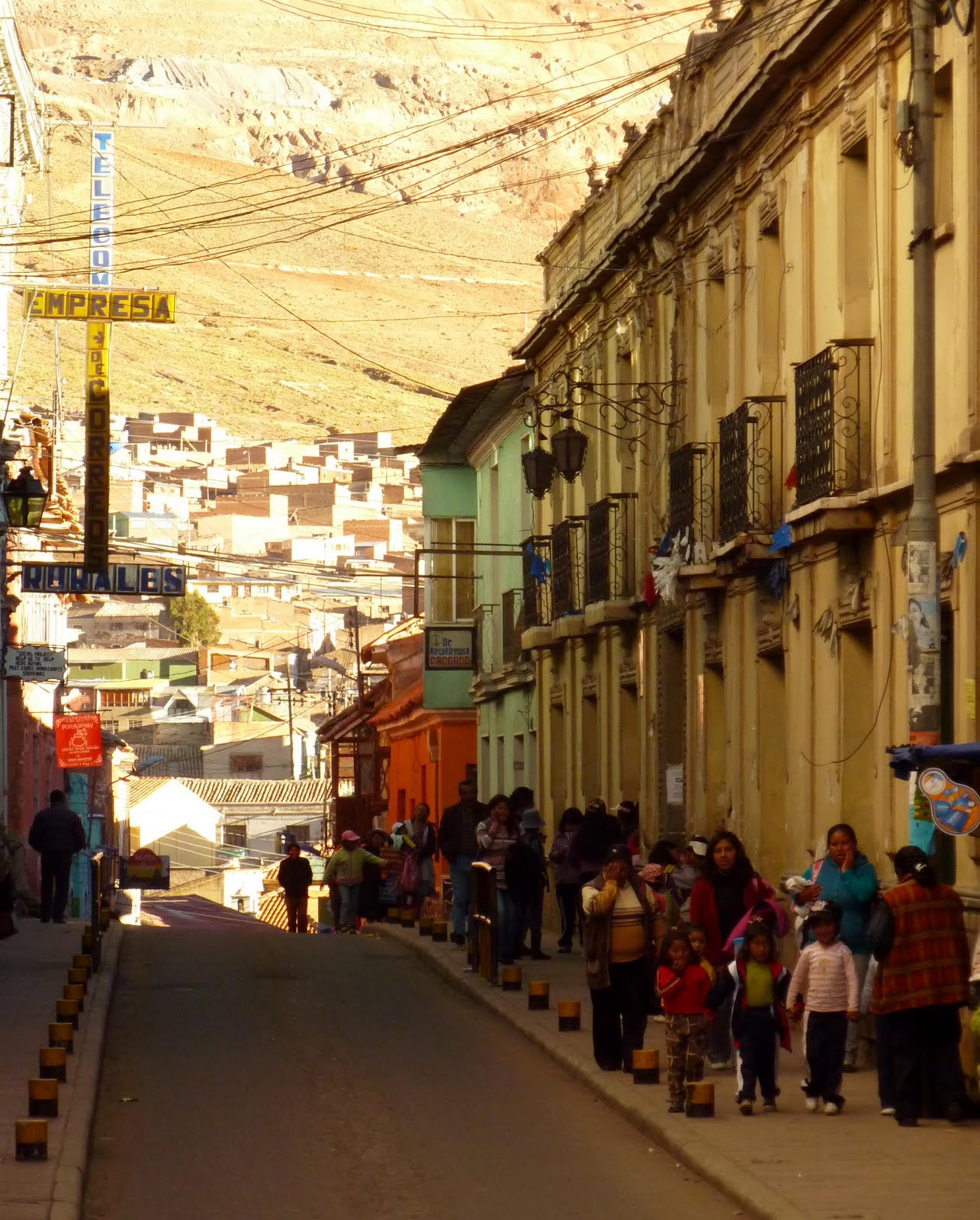
At about six in the afternoon we arrived to Potosi, the third highest city in the world. With more than 4000 meters above sea level, Potosi leaves you breathless when you take on a challenge to climb its streets. Potosi’s alleys, no more than 3m wide that zigzag through the labyrinthine of the city confusing tourists, lead us into a different world. Grand wooden portals, giant stone walls. and lots of colors in the costumes of the local women give the place a mixture of history with today's miserable reality.
Potosi -once the richest city in Latin America.
It is amazing how this city, once the richest in Latin America, can barely afford to maintain a collection of its ancient crumbling buildings, which have not seen any advances besides deterioration. It is enough to just go out to the streets to find evidence of the importance and the wealth of the city, build on the bloody money of its rich silver mines. We visited one of these active mines in a company of our guide Reinaldo, an ex-miner himself, who now dedicates his time to showing tourists the horrifying conditions of a miner world. It was soul-chilling to see that deep inside Cerro Rico nothing changed, time did not advance and did not bring any progress to make working conditions bearable.
We entered through the mines of Rosario, within the famous Cerro Rico. At the altitude of 4500 meters above sea level, the tunnels inside the mountain are flooded by water that seeps through its walls, and the rails for the mining cars that transport the minerals are barely held in place by a few metal hooks. In the areas of possible caving in, the walls of the tunnels are held up by wooden arches, although more than once we have seen those beams broken in halve right above our heads, waiting for the last push to rush to the floor.
A Potosina.
Since the founding of Potosi in 1545, the Spaniards have been sending all of “the fruits of the mines” directly to Europe, but since not so long ago many mines are now run by mining cooperatives. Each one owns one side of a tunnel the benefits of which go directly to the mining partners. Nonetheless, it is not that easy to become a partner of a cooperative. First, for some 8-10 years you must work as a miner in the lowest category and gain experience, then, if you have saved enough money, buy one of the faces of the tunnel and only then begin exploiting it for your benefit. Predictable enough though, the gains in those mines are minimal and the conditions ... as well. We went down 3 levels (separated from each other by 50 meters of mineral), and the heat became almost unbearable. The air was scarce and mixed with gases from explosions making it very difficult to breathe. It seemed that dust was constantly accumulating in our throats, as we were constantly coughing and spitting, although without actually spitting anything out. This is the sensation that you get when breathing in sulfur, lead and hundreds of sulfates that invade your lungs. I can still taste and smell that awful concoction, and it has been about 5 weeks since our visit to the mines.
A mineral separation plant.
We reached an area where a group of people was working. It was a family of a father and two sons (it is very common to have a family cooperative), and we spoke to them for a while about their life as miners.
- How long have you been working in the mine? – I ask one of the sons.
- Since I was 12. - He answered firmly, demonstrating that he was an experienced miner. - And how old are you? - Asked intrigued. - 24!
Since the age of twelve, for more than 6 hours per day, he was immersed in the inhuman reality of the underworld with no lights, no air, and no water. I could not comprehend this….. And even less I could grasp how this life was possible after I was explained how the minerals were extracted and transported to the surface. In some cases the actual mining is carried out with dynamite explosions, in others by a pneumatic hammer, but in 90% of the time the digging is done manually. It turns out, that in a cooperative everyone has to buy their own tools and materials, as well as dynamite and air for the compressors, which ends up being too expensive for the miners. The carts that transport the rocks are also pushed by hand, and in many cases the tunnels have no rails, or belong to a different cooperative, so to avoid paying for their use, the miners prefer to load 100 kilogram bags full of minerals onto their backs and transport them that way.
We left the mines in disbelief, not understanding how it is possible to work this way. Being a cooperative and working as partners, how is it possible not to use at least some type of machinery to facilitate the process?! It was pointless to look for answers or solutions.
Minors' Quarters.
After the mine we went to a plant where minerals are cleaned and separated. Trucks full of rocks extracted from Cerro Rico deposit their cargo on a rotating drum which grinds the stones, transforming then practically into dust. Then, the dust goes through a series of chemical pools, and eventually silver particles begin floating on the surface, which are then driven by a rotating blade to other pools located outside of the building. The rest is easy. The water with the silver particles is deposited onto the floor, letting the sun evaporate the water. Then the dry silver sand is shoveled into bags for subsequent transport.
And what happens then? Where does that silver go to be melted and turned into different products? Europe. Asking these questions cleared everything. Cooperatives sell 8 tons of raw mineral (a truck-full) to the separation plants for just $500. Those, in turn, for just a little bit more, sell the pure silver powder to Europe. It is there where the silver is melted, turned into merchandise, and then exported around the world. Now, it is clear where the principal revenue ends up, isn’t it? Do you know how much a silver bracelet costs? Well, after this experience you will not want to buy anything made out of this filthy, disgusting material. However, as I think about it this way, we would leave 85% of Potosí out of work.
The Silver Sand.
It makes me so angry that after so much struggle to be able to form cooperatives and work freely, the miners continue working in the same conditions as hundreds of years ago, continue to die from the same diseases, continue to live in poverty, and the money continues to stay in the same hands. The only difference is that now potosinos do not feel exploited. But how do you explain to these people that they are being exploited as slaves for the benefit of others, if since the age of 12 they are immersed in this surreal underworld of false wealth, without any possibility to study to be able to understand that they are being manipulated?
These are the feelings with which we left Potosi and its mines. The mines, where even women worked for three years while Bolivia was at war with Paraguay and there were not enough men to do the work. The mines where workers drink pure 96% alcohol to survive the suffocating underground enclosure. The mines where people do not last longer than 40 years. The mines where, unknowingly, potosinos are exploited since childhood, deceived by the fact that now they work for their own benefit. The mines that provoke nothing else than shame, disgust and sadness.
Translated from the original post " Un Cerro Rico, No Tan Rico" by Emiliano Garcia.
Por la mañana, luego de unas 10 horas de viaje despertamos en Trinidad, con el canto de unos gallos que llevaban dentro del micro mismo. Todavía bastante melancólico y triste por haber dejado Santa Cruz, comencé a averiguar las diferentes maneras que teníamos para llegar a Guayaramerin, ciudad frontera entre Bolivia y Brasil, y los métodos aunque parezca mentira, eran varios. La opción más rápida, pero también más cara y por ende descartada era el avión. Otra manera era en barcos cargueros que bajan por el rio Mamore hasta la frontera misma, pero para esto debíamos gastar cinco días, y al saber que ya navegaríamos en Brasil, era mucho tiempo, por lo que también fue descartada. Por último teníamos la flota; los buses bolivianos. Lo único que no estaba muy en claro era el tiempo que estos demoraban, ya que ante mi interrogatoria, recibí respuestas de lo más variadas; “24hs”, “36hs”, “2 días”; en fin, sería un viaje muy muy largo.
Rio Mamore
En apenas unas horas salía la flota, y no tenía sentido esperar al día siguiente, por lo que sacamos nuestros boletos y nos montamos en el bus más viejo, sucio, y rotoso que subí en mi vida, el de la empresa 1ero de Mayo. Era de los años 70, color crema con una franja roja, con butacas enfundadas llenas de polvo y caños a modo de columnas para sostener el techo. En las bauleras no solo llevábamos equipaje, sino también unas 20 garrafas de gas de 10kg; una bomba en movimiento. El chofer conducía sobre un asiento de hilos de goma y maniobraba un volante al cual solo le quedaba el hierro del interior oxidado. Sobre su cabeza, se improvisaba una litera con unos caños soldados y un pedazo de espuma a modo de colchón. Los buches sobre los asientos apenas se sostenían con alambres y algunas sogas, y el baño… bueno, no había baño.
Camiones cruzando el Mamore
Comenzamos a movernos, la odisea comenzaba. Luego de un primer tramo, en el cual todavía nos sentimos bien, donde nos parece que exageramos al prever tan duro viaje, llegamos al rio Mamore, el cual debe ser cruzado en balsa ya que es bastante ancho y si aquí no hay carreteras; menos hay puentes. Una embarcación de madera llena de filtraciones, comandada por un pequeño bote a motor nos cruza tanto a nosotros como al bus. Ya del otro lado continuamos viaje y entre pampas y selvas, atravesando todo el departamento del Beni, la zona agrícola ganadera de Bolivia, se nos hizo la noche.
Nuestra flota cruzando el Mamore
Era imposible dormir en esas condiciones. Entraba tierra por las ventanas, la incomodidad era absoluta y por si fuera poco hacia un calor insoportable. Paramos a cenar y para ir al baño, y el alivio al salir del encierro era enorme. Pero en pocos minutos volvimos al bus y las condiciones volvieron a lo primitivo nuevamente. Si viajar en la zona del altiplano es una odisea, esto no sabría con que adjetivos catalogarlo. El pasillo estaba lleno de niños y gente, y como si el bus no estuviese completo, cerca de las 3 de la madrugada se detuvo en un diminuto pueblo (Santa Rosa de Yacuma) y subió aun más gente, la cual no tenía otro remedio que viajar parada o tirada como pueda por algún rincón del micro. No sé cómo pero paso la noche y esperábamos que el llegar a destino no pasase del mediodía.
Paisaje del Beni
Pero el andar parecía interminable. El camino ahora es de tierra colorada, y el paisaje similar al de Misiones en Argentina solo que completamente llano. Grandes montes selváticos se extienden a nuestro alrededor y grandes nubes de polvo en el interior del bus. Para intentar pasar un poco más rápido el tiempo me pongo a charlar con quien se sentaba detrás mío. Un hombre de unos 35 años, de tez morena y cabeza rapada. Un fino bigote bajo su pequeña nariz, era como la continuación de una gran cicatriz en la mejilla, de la cual no me anime a preguntar su procedencia. Me contaba que venía a Riberalta a cazar, y que incluso tenía su rifle ahí, en los buches del bus sobre su cabeza. Un poco anonadado no entendía que viajara en el bus con el rifle encima, como si se tratase de una guitarra.
Lanchas que cruzan al Brasil
Me levante para pedir al chofer que se detenga para ir al baño y note que una de las pasajeras viajaba con un perro entre las piernas. La gente bajaba a orinar y se les notaba un aire de guerra, un aspecto de haberse revolcado entre el polvo durante horas sin tener siquiera un poco de agua para lavarse ni las caras. Cuando parecía que nunca llegaríamos, vi por la ventana la publicidad de un partido político, con la cara de un postulante a alcalde; de alcalde en Guayaramerin. Creo que no vi en todo el trayecto un solo cartel de publicidad, pero la política llega incluso a donde no llega ni siquiera Coca-Cola. Pero lo bueno del cartel era que si o si, debíamos estar cerca de destino. Luego de unos 15 minutos llegamos a la terminal.
Lanchas esprando su turno
Me sentía como si hubiese ganado una batalla muy dura, donde había recibido más golpes de los que había dado. Una batalla de 29 horas entre el polvo, la incomodidad, los malos olores y el malhumor absoluto; pero la habíamos ganado. Estábamos ya en Guayaramerin, prontos para ultimar los últimos detalles antes de cruzar definitivamente a Brasil y adentrarnos por completo en la inmensurable selva Amazónica.
Después de dos meses y medio de viaje y más de 7000 km recorridos llegaba nuestro primer gran descanso en medio del cálido ambiente familiar. Nos esperaban 15 días en Santa Cruz de la Sierra en casa de mis tíos quienes viven allí hace ya más de 12 años. La verdad es que no estaba cansado, pero hacía casi una semana que sabía que nos acercábamos a ver a la familia, y mi cabeza cada vez mas pedía llegar a su casa (como cuando uno tiene ganas de in al baño y estas ganas crecen incontrolablemente mientras más cerca estamos del mismo). Pero al fin estábamos allí, bajando de la flota luego de 19 horas, en el 4to anillo y la avenida San Aurelio.
Descansando en el Camino
Me alegró mucho poder comer todos juntos, jugar con mis primos y compartir un buen rato con mi tío. Los mediodías los ocupaba en ir a buscar a mis primos a la escuela. Al más chico, Brian, solo fui una vez, ya que la mayoría de las mañanas acusaba estar cansado, con mucho sueño y terminaba quedándose en la casa. Pero a los que si traía cada día era a Nico y a Thiago, a quienes les es un poco más difícil escapar al rigor escolar. Y en las tardes llegaban los campeonatos de Rally en la Play, que en más de una ocasión terminaban en algún revoleo de control o reseteada en medio de algún tramo. Cuando no estaba en la casa, acompañaba a mi tío al trabajo, a ver caras conocidas y charlar un poco en el transporte. Y en las noches predominaron las pizzas caseras a la parrilla, que Brian ofrecía bajo el slogan de “Pizzas Gustavito, el que no las come se queda chiquito”.
Camino al Amboro
Teníamos ganas de visitar el Parque Nacional Amboró, que a pesar de estar muy cerca de la ciudad, todavía no lo conocía. Averiguamos con agencias de viaje, ya que no dejan entrar al parque solos, y nos parecía muy caro lo que pedían para pasar apenas una o dos noches dentro de la reserva. Decidimos aprovechar el cuatriciclo de mi tío e intentar ir por nuestra cuenta y ver si conseguíamos algo mejor en las mismas comunidades en alguna de las entradas al lugar.
Acampando en Villa Amboro
El Amboró es un parque muy nuevo y dentro de el conviven varias comunidades indígenas que viven de la ganadería y el cultivo. Es por esto que el estado en el momento de nombrarlo Parque Nacional, reservo una franja que rodea todo el predio en la cual emplazaron sus casas los aborígenes y montaron sus pequeños pueblos donde pueden seguir cultivando y criando sus vacas y gallinas. Así luego de averiguar un poco en Buena Vista y ver cuál era la mejor opción en un mapa que copiamos a mano en un papel, decidimos ir a la entrada denominada Campamento Macuñucú.
Mirador del Amboro
Allí el camino termina justo en medio de una cancha de futbol, la cual rodeada por chozas de madera y paja hace de plaza principal de la población. Como también había visto en Ecuador, las comunidades construían sus viviendas alrededor de una cancha, donde el jefe de la misma era el dueño de la pelota. El pueblo se llamaba Villa Amboró. Uno de los chicos nos explico que su hermano, quien era guía, no estaba allí en ese momento, sin embargo él mismo nos podía llevar al parque a hacer unas caminatas por solo USD 10, nada contra los casi USD 150 que nos pedían las agencias. El problema es que ya era tarde y no hacíamos a tiempo a entrar y salir en el día, por lo que luego de la aprobación de la gente de la comunidad, decidimos acampar y pasar la noche en la mismísima cancha de futbol, en medio del pueblo. Sería como un equivalente a armar la carpa en la Plaza de Mayo en Buenos Aires, solo que aquí restamos varios habitantes; dejando tan solo 200.
Villa Amboro
Por la noche como si fueran murciélagos, aparecía gente de todos lados. Luces de linternas cruzaban la cancha (el pueblo no tiene luz) y motos sin ningún tipo de iluminación, desaparecían en el monte sin entender a donde se dirigían. Bajo un cielo tapizado de estrellas, caminaba un viejo con una radio bastante grande, como del tamaño de una caja de zapatos, colgando del cuello con una cuerda, desde donde no salían sonidos demasiado entendibles para nuestro oído. Dentro de los alcances de mi imaginación, nos encontrábamos en un lugar de lo más parecido a Macondo, de “100 Años de Soledad”.
Desde arriba de la Cascada
Cerca de las 9 de la mañana comenzamos a caminar. Dejamos el cuatriciclo en la casa de don Marcos, uno de los pobladores más antiguos de Villa Amboró, y comenzamos a adentrarnos en las yungas bolivianas. Muchísima vegetación cargada de humedad extrema y el cruce de varios ríos nos llevo a nuestra primera parada. Eran dos cascadas no muy grandes pero si muy lindas por su entorno y emplazamiento. A los pies de su caída se encontraban profundas pozas de agua donde incluso pude bañarme un rato.
Pizzas Gustavito
Seguimos caminando en busca de una gran cascada de unos 60mts de altura, aunque no teníamos demasiada esperanza respecto del caudal de agua con el cual nos íbamos a encontrar. Era una enorme pared de piedra de forma semicircular y desde su punto más alto caía un espray, una pulverización que apenas nos mojaba como llovizna de verano. Por uno de sus lados subimos a la parte alta de este gran salto y descubrimos el rio que lo alimentaba, el cual estaba prácticamente seco. Era tan poca el agua que caía, que se perdía antes de llegar al suelo.
Nico y Brian en Rio Selva
Por último, adentrándonos más y más en la gran selva, fuimos al mirador del Amboró, desde donde se puede apreciar el cerro que lleva este nombre, y con el que a su vez fue bautizado el parque. El camino se pone más interesante en este tramo. Arboles con gigantescas raíces, helechos gigantes, lianas y palmeras van quedando a nuestro lado mientras ascendemos hacia el mirador. Atravesamos incluso una parte donde el sendero era muy angosto y con precipicio a ambos lados, con grandes árboles de mara y piedras en el suelo, similar a alguna escena de Avatar. Cuando por fin, la imagen a lo lejos de ese cerro de piedra cortado, rodeado completamente por una abundante vegetación de un verde bastante oscuro nos dice que llegamos al final del camino. Es increíble el alcance de la selva, la cual parece no tener fin. Parece mentira estar a escasos 50km de una gran urbe con más de dos millones de habitantes. De esta manera volvimos al pueblo y luego a Santa Cruz, a tomar un buen baño y descansar un poco luego de un largo día de caminata y mucho, mucho calor.
Rio Selva Resort
La semana siguiente fue muy tranquila, una vez más en familia, compartiendo tiempo con todos e intentando cargarnos de nuevas energías para continuar el viaje. El fin de semana fuimos a un Resort a unos pocos kilómetros de Santa Cruz, donde por si fuera poco, tuvimos más descanso aun; tomando unas sesiones de sauna, piscina, y descansando en una cabaña con todos los lujos. Incluso con televisión, donde pude gozar de un maratón deportivo sin igual, con un Del Potro – Djokovic en el polvo de ladrillo parisino, seguido de la Formula 1 en Mónaco, el WRC en Córdoba, Turismo Carretera en Buenos Aires, las 500 Millas de Indianápolis, y como broche de oro, la final de la Champions League en Wembley entre Barcelona y Manchester United.
Todos en la Despedida
Bastante melancólico y con mucha tristeza dejamos Santa Cruz. Tenía muchas ganas de quedarme un tiempo más, pero debíamos movernos, de lo contrario cada vez seria más difícil volver a arrancar. Por otra parte ya teníamos fecha para dejar Sudamérica, por lo que si queríamos tener tiempo para conocer lo mejor posible el infinito Amazonas, era mejor comenzar a hacer kilómetros, por lo que nos subimos a una flota con destino Trinidad. Brasil esperaba…
Muy a pesar de que todo el mundo cree que La Paz es la capital de Bolivia, esta es tan solo la sede del gobierno nacional, cuando el título oficial de capital según la Constitución Política del Estado le corresponde a Sucre. Prolija por donde se la mire, con sus construcciones de estilo colonial y sus prolijos parques, Sucre merece ampliamente el titulo que se le otorga. Sus calles angostas nos conducen a través de arcos que nos introducen en la zona céntrica histórica.
Plaza de Sucre
Su plaza, es por mucho la más prolija de toda Bolivia. Arreglos florales en todos sus parques, el césped completamente cuidado y monumentos limpios y sin grafitis le dan color al ya colorido que otorgan sus pobladores caminando por los senderos. Era sábado por la noche y queríamos descansar ya que los domingos, a escasos 65km se realiza una de las ferias-mercado más típicas e ancestrales de Bolivia, en la ciudad de Tarabuco, y claro está, no nos lo íbamos a perder.
Cultura Yampara
Dos horas sobre pequeños autobuses depositan a la gente en esta pequeña ciudad donde los lugareños compran provisiones y los turistas artesanías a por doquier. Alrededor de la plaza y en las calles aledañas se desparraman cientos de puestos con los más variados productos. Desde gorros, mantas y guantes de alpaca, hasta picos y palas, pasando por frutas, verduras y carne. Esta pequeña ciudad fue hace miles de años habitada por la cultura Yampara, a quienes aun hoy se los ve por las calles de Tarabuco, con sus cascos típicos y grandes ponchos de colores.
El tiempo nos perseguía de cerca, y luego de visitar una exposición de arte boliviano y deleitarnos con algunos bailes típicos en los cuales incluso Valeria tomo parte, retornamos a Sucre para no perder nuestro micro a Santa Cruz.
Comiendo en Tarabuco
Con ganas de recorrer la capital boliviana con más tiempo y conocer más sus suburbios, dejamos Sucre para dirigirnos a Santa Cruz a visitar a mis tíos, primos y ahijado. Nos esperaban aires de descanso en una casa de verdad, con camas de verdad y duchas 100% reales.
Cerca de las seis de la tarde llegamos a Potosí, la tercer ciudad más alta del mundo. Con sus más de 4000 m.s.n.m., Potosí deja sin aliento a cuanto gringo ose por trepar sus calles. Enormes portales de madera remachada, gigantescos muros de piedra e infinidad de colores en las vestimentas de sus mujeres, otorgan al lugar una mixtura de historia con actualidad difícil de explicar. Callejones de no más de 3mts de ancho zigzaguean por la ciudad trazando laberintos que no hacen más que confundir a los turistas, aunque su solo transito ya nos introduce en un mundo diferente, sin importar demasiado a donde nos termine depositando.
Calles de Potosi
Nos acomodamos en lo que creo debe ser uno de los peores 3 o 4 hostales de Potosí; el hostal La Paz. Lo único bueno era la ubicación y que las habitaciones eran privadas, porque el aspecto de sus patios, el continuo llanto de niños y el insoportable olor a humedad mezclado con insecticida hacían dudar si los $Bs 25 que pagamos no serian mucho para lo complicada que se veía venir la noche. Los revoques de las paredes se caían con el sonido de los pasos sobre los pisos de madera deteriorados, y la cama con una mesita de madera a modo de escritorio a su lado me daba la sensación de que alguna vez un San Martin o algún Simón Bolívar habían escrito alguna que otra carta informando sobre sus movimientos de guerra.
Es increíble como esta ciudad que supo ser la más rica de toda América Latina, hoy apenas mantiene en pie sus antiguos edificios, sin ningún tipo de avance más que el del deterioro. Alcanza con sacar los autos de sus calles para retroceder cientos de años y colocarse entre colonizadores peleando por sus riquísimas minas de plata. Minas que visitamos para darnos cuenta que dentro de ellas, el tiempo realmente nunca avanzo, nunca trajo consigo ningún avance para hacer el trabajo más saludable, nunca le devolvió a los potosinos la riqueza que alguna vez ostentaban sus calles.
Mujeres Potosinas
Ingresamos por las minas del Rosario, dentro del famosísimo Cerro Rico. A más de 4500 m.s.n.m. los túneles dentro de la montaña se encuentran inundados de agua por las filtraciones de sus paredes y los rieles para los carros que sacan el mineral apenas si se sostienen con algunos ganchos. En las zonas donde el túnel es factible de un derrumbe, arcos de madera son emplazados para sostener las rocas, aunque en más de una ocasión observamos por sobre nuestras cabezas maderas quebradas esperando un mínimo empuje para precipitarse al suelo.
Callejones
Desde su fundación en el año 1545 los españoles obtenían todo el fruto de los minerales el cual era llevado directamente a Europa, pero de un tiempo hasta parte, las minas se convirtieron en cooperativas por lo que hay quienes son dueños de una cara del túnel y todos los beneficios que esta les brinde pasan directamente a el minero socio y sus súbditos. Aunque no es tan fácil llegar a ser socio. Primero se debe ser minero de la más baja categoría, adquirir experiencia, y con el paso de al menos unos 8 a 10 años, juntar el dinero para comprar una de las caras y comenzar a explotarla para su beneficio. Pero muy a pesar de lo que parece, las ganancias son mínimas y las condiciones… también. Descendimos 3 niveles (separados entre ellos por 50mts de roca), y el calor se torna casi insoportable. El aire escasea y mezclado con los gases de explosiones y movimiento del propio cerro hacen muy difícil respirar. Incluso parece como si juntásemos polvo en la garganta, por lo que estamos constantemente escupiendo, aunque no escupimos nada, ya que esta sensación es la que da el respirar azufre, plomo y cientos de sulfatos que invaden nuestros pulmones y los de quien ande por el lugar.
Mineros Inexpertos
Llegamos a una zona donde un grupo de personas estaban trabajando. Era una familia, con el padre y sus dos hijos (es muy común que se asocien entre familiares), y pudimos hablar un rato con ellos sobre inquietudes que teníamos.
-Y cuanto hace que trabajas en la mina? – pregunte a uno de los hijos.
-Ya 12 años – me respondió con firmeza demostrando ser un experimentado minero.
-Y cuantos años tenes? – pregunte intrigado.
-24!
Desde los doce que estaba inmerso en ese mundo subterráneo por más de 6 horas por día, sin luz, sin aire, sin agua, en condiciones inhumanas. Mi cabeza no podía entenderlo. Y menos lo entendí luego de que me explicasen la manera en la cual extraen el mineral. En algunos casos realizan detonaciones con dinamita, en otros utilizan un percutor neumático, pero en el 90% de las veces el trabajo es a mano. Resulta que al ser cooperativas, cada uno debe comprar sus materiales y tanto la dinamita como el aire de los compresores les son caros para su trabajo. Incluso los carros para transportar las rocas son empujados a mano, y en varios casos los túneles no poseen rieles o bien se encuentran en un túnel el cual no les pertenece y por no pagar por su uso a otros socios, prefieren cargarlos en sus espaldas en bolsones de hasta 100kg.
Minero con uno de los Bolsones de 100kg
Salimos de las minas indignados, sin entender cómo se puede trabajar de esta forma. Siendo cooperativas y trabajando como socios, como no poder al menos utilizar algún tipo de maquinaria para facilitar los movimientos. Era en vano buscarle soluciones.
Nos dirigimos a un ingenio, una planta separadora de minerales. Allí llegan los camiones con las rocas extraídas del Cerro Rico, las cuales son depositadas en un tambor giratorio que muele las piedras hasta transformarlas prácticamente en polvo. Luego, estas van pasando por una serie de piletas, las cuales con el aditamento de ciertos químicos, hacen flotar las partículas de plata, las cuales son empujadas por unas palas giratorias hacia otras piletas que se encuentran en el exterior. Desde ahí lo que queda es más fácil. Se echa el agua con los minerales sobre el piso mismo, dejando que el sol evapore el agua y se carga la plata con pala en bolsones para su posterior transporte.
Carros para extraer los Minerales
Y a donde funden la plata y la trabajan para realizar diferentes productos? Esa simple pregunta respondió todo. En Europa. Las cooperativas venden 8tn de piedra en apenas USD 500 a los ingenios, los cuales luego de separar los minerales venden a poco más toda la plata en polvo a Europa. Son ellos quienes la funden, la utilizan en fabricación de diferentes productos y la exportan a todo el mundo. Está claro dónde queda el gordo de la ganancia no? Ustedes saben cuánto sale una pulserita de plata? Después de esto no dan ganas de comprar ninguna cosa que sea de este asqueroso material plateado. Aunque pensándolo diferente, dejaríamos sin trabajo al 85% de Potosí.
Ingenios
Da mucha bronca que luego de tanta lucha para que los mineros creen cooperativas, ahora que lo logran sigan trabajando en las mismas condiciones que cientos de años atrás, sigan muriendo de las mismas enfermedades, sigan viviendo en la misma pobreza, y que el dinero siga quedando en las mismas manos. La única diferencia es que los potosinos ahora no se sienten explotados. Pero como explicarle a esta gente que los utilizan como esclavos para el provecho de otros, si desde los 12 años se ven inmersos en este sub-mundo irreal de riqueza, sin posibilidad de estudio para comprender que están siendo manipulados?
Cerro Rico
De esta manera dejamos Potosí y sus minas. Minas donde incluso trabajaron mujeres durante tres años mientras Bolivia estaba en guerra con el Paraguay y no había hombres para explotarlas. Minas insalubres donde sus obreros toman alcohol puro a 96 grados para soportar el encierro. Minas donde la gente no supera los 40 años de edad. Minas donde sin saberlo, son explotados desde niños todos los potosinos, engañados con que ahora trabajan para su propio beneficio. Minas asquerosas… minas de mierda…
The third country in our trip itinerary was Bolivia - the “wild, wild west”, the country where anything goes, according to Argentines.
Bolivian south is very similar to the north of Argentina in its nature, traditions and even ethnic population, so I didn't feel a strong difference when we were finally on the Bolivian side. The one thing that did strike me was the border itself. There are three different gateways through which one can get to the other side: one is through the immigration office, the other avoiding it (it is up to you to register, and enter the country legally), and the third one is through the walking contraband bridge.
"Contrabando de hormigas".
It is a shocking scene to observe hundreds of people (many women and mostly indigenous) rapidly shuffling across the bridge with cargo twice their weight tied onto their backs. They carry goods from the Argentine side to the Bolivian side as fast as they can, then run back to the Argentine border to repeat it all over again. These people are contracted for a meager pay per trip to transport merchandise on their backs so that the owners of the cargo don’t have to pay foreign taxes. There is a law, according to which you can bring as many goods into the country as you can physically carry. So, this is the loop hole that is used and abused right in front of the customs officials 24/7! Hundreds of trucks arrive to the boarder daily, unload their cargo, send it to the other side on people’s backs, and load it back up to then continue the trip. It is obvious that these kinds of things happen on every border in Latin America, but seeing it with your own eyes shocks…
Salt and more salt...at teh Salar de Uyuni.
Anyways, having crossed the border (choosing the immigration office option) we were in Villazon, Bolivia. As Villazon turned out to be a typical border town with dusty streets and shabby looking constrictions, we decided to get on the first available train to the mythical Salar de Uyuni (12 hours away).
The Salar de Uyuni is the largest salt flat in the world covering 10,582 square kilometers. About 40,000 years ago this salar was covered by a prehistoric lake Minchin. When it eventually dried out it became an endless white salt desert, which supposedly grows larger and deeper with every year. According to our guide Juan, in the deepest part of the desert, the layer of salt reaches down to 14 meters (20 meters according to Wikipedia). Salar de Uyuni is located in the Oruro and Potosi departments of the country, which are a part of the Bolivia Altiplano or high plateau, a part of the country with very little population and unbelievable natural beauty. The Salar de Uyuni is surrounded by a number of other deserts, which in their turn are surrounded by mountains with peaks above 4,000 meters.
Surreal!
I have never heard about this place until I met Emi, whose Facebook profile photo was taken in the Salar de Uyuni. Apparently, this natural wonderland is becoming popular at the speed of geometrical proportion. Ten years ago this salar received about 9,000 visitors, and now this number is up to 70,000. Even though the place is becoming more and more touristy, and there are gringos from all over the world on every corner in the village of Uyuni, this adventure excursion doesn’t lose its attraction. If you are looking to see some mind blowing landscapes, have some Latin American adventure on a limited budget, and disconnect from the modern developed world you must come to the Bolivian Altiplano. You will have something to remember!
This world is amazing!
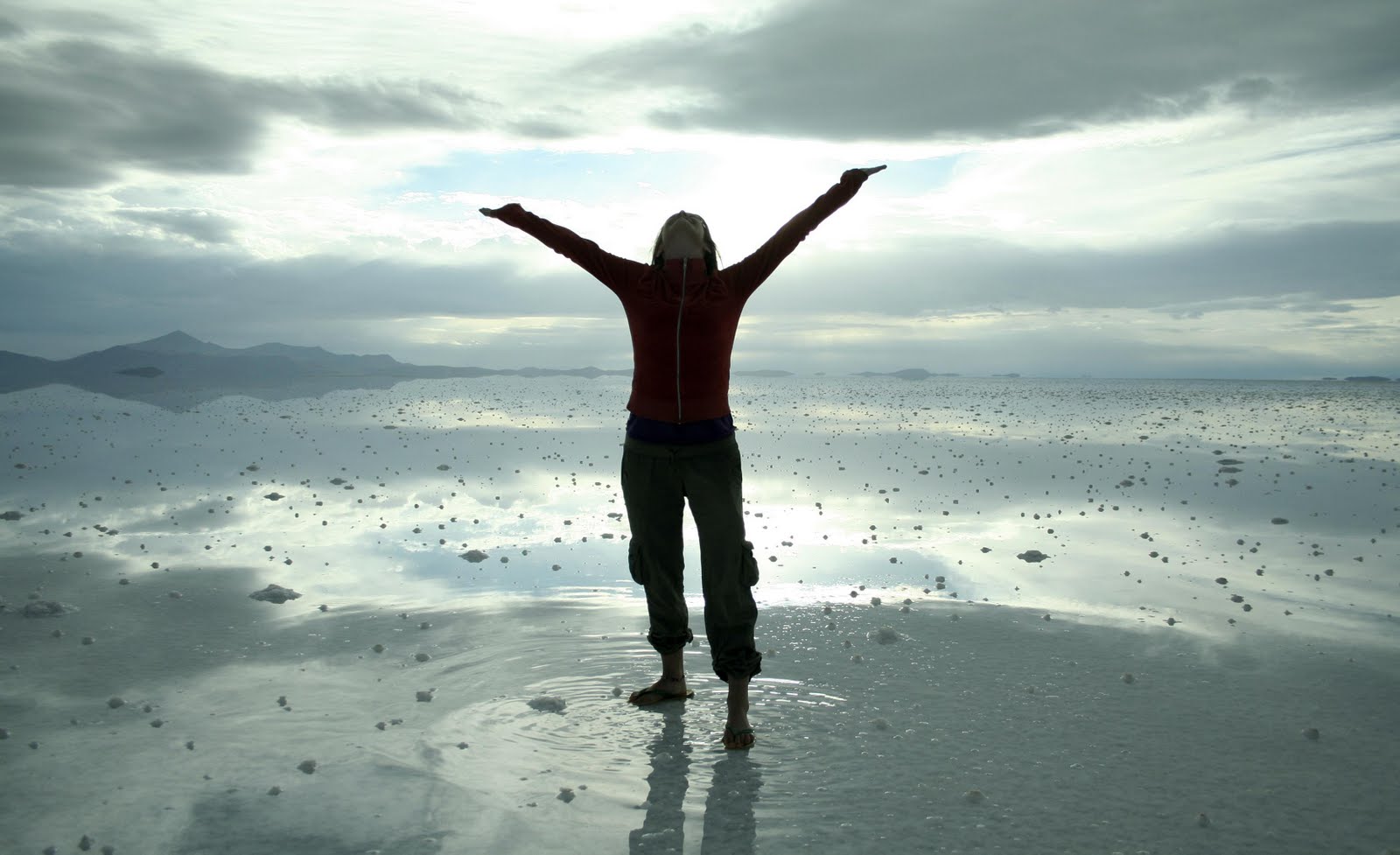
From all of the places I have been to in the world so far, this was the most different and breathtaking place I have seen. With a little bit of water on the surface, the salt transforms into a perfect mirror reflecting the sky. The sensation is absolutely surreal when you feel as if you are floating in the clouds, as you can’t tell where the earth ends and the sky begins. Looking through the windshield of our SUV I saw no horizon, and it felt as if we were driving directly into the clouds!
Just another lunch spot...
As most other seas, this sea also has islands above its surface. We stopped for lunch at one of them, Incahuasi or the Fish Island, during our first day of the trip. The coral island covered by enormous cacti (some 1000 years old) is not only gorgeous by itself, but also offers a panoramic 360% view of the whole salar. I felt as if I was on another planet, or in some parallel reality where laws of physics did not apply. Looking all around I felt as if I was surrounded by a never ending ocean, but somehow it was white and solid. What also blew my mind in that virtual world, was that I could not trust my eyes. When we were on the way to the Fish Island, I asked how far it was, expecting to hear that it was no farther than 10 minutes away (it looked like we were right next to it). The reply was that it was some 50 kilometers away, which took us about 40 minutes to cover. It felt as if the perfect white planes around played tricks on us. Somehow, everything appeared to be much closer, and moved much faster as it did in reality. It was INSANELY SURREAL…..!
Parallel worlds.
This time around, as we did not have our own transportation, and no funds to rent any, we joined a group of other 4 travelers and a local guide to take us to the salar and through the deserts of the Altiplano. It is absolutely worth doing it this way. You pay about $100 for 3 days of travel (close to 1000 km.) + all meals + lodging + a guide/driver! Nonetheless, we decided that the next time we do it (we are determined to return one day), we do it our own way and at our speed, stopping where we want, and staying the places we like for as long as we want. There were so many incredible spots where we wanted to stay and soak in the quiet beauty and peace, but we only had 3 days and a 1000 km to cover…
The train to nowhere.
The first day of the trip we spent crossing the salt desert. We left the town of Uyuni at about 9 am and had our first stop about 30 minutes later on the town outskirts at the steam train cemetery. The iron ruins of these once impressive machines are quite picturesque and are great for photo projects. Other than that, it is actually quite a sad seen, exhibiting little respect for the environment with trash of all sorts spread out in all directions. Garbage, and especially plastic waste is something that never stops shocking me wherever I go. Beverages and other products in plastic containers took over the world a long time ago, but it really feels like an invasion on the environment when you see those millions of plastic bags and bottles all over the ground in the developing countries…
Almost flying...
Why isn’t there a regulation for ANY-KIND-OF-COLA to build a plastic recycling plant for every soda plant that exists?! Besides, before selling their plastic crap, they should prepare the local population by educating them that plastic does not rot and decompose if you throw it on the ground, like they do with vegetable and animal waste. It takes 450-1000 years for a plastic bottle to break down , and about 500 years for a plastic bag (not even decompose)!!! Apparently, humans have never been environmentally conscious and always tossed they waste wherever they fancied. Well, it was not a big deal until it was all biodegradable…
A place to meditate and levitate.
By the end of our first day of the trip we reached the part of the salar which was still covered with water from the rainy season. Looking out of the window it felt that we were on a boat navigating and not driving in a car, especially when the water got deeper and we could hear the wake waves splashing as we passed. We were especially lucky to reach this part of the salar right when the sun was getting ready to set behind the horizon. The scenes we saw that night were impossible to describe… I can only say that it was probably the most memorable sunset I have seen in my life.
The "Rock Tree".
That night we were pleasantly surprised by our accommodations. We were supposed to stay in a group hostel, but because we reached it later that other travelers, it was full and we had to drive an extra hour to another village, where we were placed in one of the salt hotels. Not only that we had our own individual rooms, but we also actually had an opportunity to stay at a hotel completely made out of salt. Everything, from floors to beds and tables was made out of pure salt. It was especially fun to find all this salt useful at dinner time when I needed to spice up my food.
The "Red Lagoon".
The next day turned out to be a special day of adventure for Emi. In the morning, after about an hour of driving, our guide Juan confessed to us (only Emi and I could understand, as the rest did not speak Spanish) that he almost did not slep the night before and was not feeling too well. He told us that one of his relatives died in a mining accident that night, and so between the sorrow and the alcohol he almost did not catch a wink. We did not know whether to believe the story or not, but the part about being tired and hung over was true for sure, so very quickly it as decided to replace Juan with Emi as a driver. It was all fun and exciting, the only thing is that in some places there were no roads and we drove right in the middle of an open desert not knowing if we were going the right direction or not. Every so often Emi woke Juan up to check about directions, but every time the semi sleepy gesture directed us to go straight… We had to trust what he sad and continue towards the horizon. According to some rumors, a number of people got lost and died in those deserts trying to establish records by crossing them on foot. We were not on foot, but were still quite worried about getting lost. We had no GPS, maps were useless in places where there were no marked roads, and compasses do not work there (because of the magnetic minerals in the ground).
Flamingos.
By lunch time, after some hours of R&R, Juan was back on. Shockingly, we ended up at one of the lagoons we were told we were going to see. It was overcast that day and we thought that we were not going to be able to take photographs that do justice to the place. Nonetheless, by the time we reached the lagoon, the overcast turned into grayish-white dramatic cotton balls that sat on the mountain peaks. It was so beautiful that I wanted to run around, jump and scream to feel that it was real and I was not dreaming. And so I did! It was really fun and somehow liberating.
Salt roads.
In the afternoon there were more deserts, more lagoons and another sunset. I really have no words left to describe what we saw. You should just come and see it for yourself! That night our sleeping arrangements were a bit different and we all had to sleep in a dormitory with a straw ceiling. I had no problem with any of this, but our German companions freaked out and wanted to have Juan find as a different place. They read in their guide book that these straw roofs can sometimes have these insects “vinchucas”, and if bitten, you become sick with this lethal disease “chagas” which has no cure. It is true that this danger exists, but since all of the 70,000 tourists sleep in these places somehow it must be safe. Besides, there wasn´t much of a choice of hotels in the middle of a desert! Oh, those Germans!
Hot springs.
The next day, all safe and sound, first thing in the morning we went to take a dip in some hot springs. I was excited to finally experience hot springs as they come in nature. The place had a little shack/changing room, and nothing else except for a steaming hot beautiful lagoon surrounded by far away mountains. We played in the healing hot waters until Juan dragged us out, and packed us back into his car. We didn’t have much time because we had to get to the Chilean border to drop off Linda, one of the Swiss members of our crew. There, we learned that dropping someone off did not mean that we got to travel back to Uyuni (500 km) in more comfort. Very quickly Linda was replaced with 3, not exactly little, guys from England and Israel. With 8 of us in this “have seen it all” TOYOSA (Santa Cruz type of Toyota) ´96 SUV we started to head back.
Time to go back...
The one stop that impressed me that day was at the Red Lagoon. The water in that lagoon was really red! It is that color because of the algae that do photosynthesis in a particular way that turns them redish. It is quite strange to see red water, but it was not the water that made me want to stay there for much longer. Deep inside the lagoon there are hundreds and hundreds of pink flamingoes, which slowly walked in the water looking for the best place to feed. There are three kinds of South American flamingos: the Chilean, Andean and rare James's Flamingos. There are very few species left of these birds, the natural habitat of which is being continuously threatened by human activity.
Something is wrong with the horizon!
The places where we travelled in those tree days were not all protected lands, and only a part of these deserts is within a national park, but the rest can be cultivated, excavated and exploited in any other way. This whole part of Bolivia should be a protected area! That place is really a world treasure which will disappear unless something is done…
A number of hours later we were back in the village of Uyuni. It felt strange and abrupt to be back in “civilization”. I did not get enough of those deserts this time, so will have to come back…