I have never been to Asia before, so I was particularly acute to some things that jumped at me as something very weird. As soon as we boarded our China bound train it was clear to me that the Chinese are very hungry people. In our 4 person train compartment our Chinese neighbors took a break from eating only when they were deep asleep, which was from about 9pm to 5am (not exactly my schedule). In the morning, that is before sunrise, we were woken up by the sucking sound of the instant noodles being inhaled by our new friends accompanied by a mortal stench of garlic coming from the hallway, where others were shoving in their breakfast favorites. I am not being mean or condescending when I use such strong verbs as “shove” when I describe these eating habits. In China (at least in Beijing) people are always in a rush and they do not appear to let themselves enjoy eating. They eat not to be hungry and do it as quickly as they can. When it comes to noodles, they “inhale” those suckers very noisily in order to cool them down that way. Why not let them cool in a bowl and then eat normally and without the annoying noises?! Oh, and the spitting….! I have never heard so much and so frequently people want to spit stuff out their mouths. Everyone does it from grown men to young children and women. I don’t know if there are sick all the time or just want to attract attention, but it sound and looks so awful that it is extremely difficult to ignore. I am not judging. I guess “it is not good, it is not bad, it is just different”, but way too different for me…
Emi's beard was the #1 attraction on the Great Wall.
As soon we got off the train in Beijing we were reminded that China is a super over populated giant and the land of competition where only the fittest survive. The Chinese seem to not see/not care what so ever whether there is something or someone in front of them. Whatever that is that is in front of them is in their way, therefore needs to be moved, pushed or removed out of the way. You pretty much have to walk and do things at the speed of the people around you, unless you want to be run over. When people run into you (they do it all the time) they don’t even look at you, let alone say “I am sorry” or something along these lines. The Chinese will always try to push you out of their way to get into a train car, cut you in line to get into a bus, sneak money to a cashier at a grocery store to get the shopping done faster and so on. It is really, really annoying at first, but then, once you learn that there is no such thing as politely letting someone go first, you realize that you just have to make your way through and you start acting the way the Chinese do and everything starts working out for you.
The Red Hat tour group.
Once we have finally settled in and made our rounds in town plazas, markets and walking streets, I have notices a couple of other interesting things. Most of the younger Beijingers are very fashionable and seem to be a little too obsessed with appearance. Fashion I like very much, and it was a breath of fresh air for me to see some interesting clothing on people after months and months that we have spent in south America and Russia. Nonetheless, men’s fashion seemed a little over done for my taste. Besides the latest fashion in their clothing they are absolutely obsessed with their hair. Oh, you should see those hairdos! That is right, they are not just haircuts, but daily styled hairdos with gel, hair spray and whatever else other hair products. The actual haircuts are really quite good and elaborate the opposite of what you might get at a US Hair Cuttery. But it is not the haircuts, but the amount of attention that they received every time those gentlemen left their house that amazed me.
The obligatory "Fire Spirit".
Those guys would also sneak “check up” stares every time they passed a mirror, adjusting the do with their female-like manicured fingers. This is something that I have never seen anywhere else before. Many of the Chinese (and Asians in general, as I have discovered later) keep their finger nails long. Supposedly, it is a sign of a class demonstrating that you are not a peasant who works in the fields. I am sure there is a reason for this and it must be an important one. Nonetheless, I could not (and still can’t) hide my disgust when I see those male hands with long thick fingernails. I have no idea why it makes me feel this way, because I have nothing against long finger nails on women. Why does it make a difference to me I have no idea, but it does. Personally, I think all of those guys should relax about their hair a little bit, cut their fingernails and they’d be a lot more attractive, even though they are not much of my style.
En las peleas de pareja se dice que los problemas se arreglan “de las puertas para adentro”; en los juegos de naipes, “los de afuera son de palo”; y un consejo de padre diría “mejor no te metas”; sin embargo estas frases o refranes no parecen haber sido traducidos al ingles, ruso, chino, ni mucho menos al vietnamita. Cuando en 1964 las diferencias políticas entre Vietnam del Sur y Vietnam del Norte eran insostenibles, ambos no dudaron un momento en recibir apoyo bélico desde sus pares capitalistas y comunistas respectivamente, transformando el enfrentamiento en una incansable guerra de más de 10 años, donde el numero de víctimas la convirtieron en la más sangrienta después de la Segunda Guerra Mundial. Un enfrentamiento que ni siquiera las reglas de Derecho Internacional lo consideraron como lo que fue, ya que Estados Unidos no entro en conflicto contra ninguna nación, debido a que no solo Vietnam del Norte no era un país en sí, sino que tampoco hubo declaración ni invasión alguna que Vietnam del Sur y su gobierno no hayan solicitado. Es por esto que al escribir guerra de Vietnam, debemos hacerlo en letra minúscula ya que no hubo declaración alguna por ninguna de las partes. De todas formas no creo que esto último hubiese cambiado mucho la historia. Una vez vi una foto del presidente Roosevelt mientras firmaba la declaración contra Alemania en la Segunda Guerra Mundial, posando y sonriendo con todos los que lo rodeaban… poco serio no?
Ciudad Imperial en Hue
Desde que dejamos el norte del país de a poco nos fuimos empapando mas y mas de este conflicto del cual, debido a la libertad de prensa aprovechada ante la no declaración de guerra, se saben muchas más cosas de las cuales los gobiernos hubiesen querido. Una guerra con cualidades completamente diferentes a todas las anteriores. Una de las características principales que marcaron los ataques estadounidenses eran los bombardeos aéreos donde en más de una ocasión (y esto reconocido tiempo después por soldados americanos), el objetivo era disparar a “todo aquello que se mueva”. Así fue que al recorrer la Ciudad Imperial en Hue, antigua capital y línea divisoria entre el norte y el sur, solo pudimos contemplar una parte de esta ya que la gran mayoría fue destruida ante los incontables bombardeos. Una verdadera pena ya que con lo poco que queda en pie, se puede adivinar una arquitectura única y muy vietnamita que en pocos lugares puede ser contemplada. Lo mismo sucede en Hoi An y las ruinas de My Son, donde de los más de 70 templos y torres de más de 1000 años de antigüedad que se encontraban en el lugar, tan solo quedan unos 10 en pie, destruidos también por bombas lanzadas desde los B-52.
Bombardero B-52 (www.jkvshimself.com)
Uno de los más feroces ataques fue la operación Rolling Thunder aunque la posterior campaña Linebaker (155.548 toneladas de bombas en 41.000 misiones aéreas), lanzada personalmente por el presidente Nixon donde el objetivo era localizar y destruir no solo asentamientos militares, sino todo aquello que facilitara el abastecimiento y logística de Vietnam del Norte, fue una de las más feroces y desesperadas salidas ante la inminente derrota. Puertos, instalaciones petrolíferas, aeródromos, muelles, y casi la totalidad de vías férreas fueron destruidas, como así también toda industria existente que significara abastecimiento de suministros y materiales. Incluso escuelas y hospitales fueron bombardeados, y aldeas enteras borradas del mapa. “La aldea ya no existe, fue destruida por los estadounidenses, reconstruida y después destruida nuevamente por ellos. Después de esto se le llamo zona de fuego libre. Dijeron que, con la aldea muerta, ya no había razón para que nadie fuese allí, ni siquiera para visitar la tumba de nuestros antepasados” (palabras de un aldeano reporteado durante la guerra).
Torturas (www.gordspoetryfactory.blogspot.com)
El motivo principal del constante uso de aviones y ataques aéreos, fue que Vietnam del Norte combatía bajo las reglas del movimiento guerrillero del Viet Cong, obligando a los americanos a salir de las tradicionales líneas de frente y tener que buscar al enemigo quien se encontraba replegado y preparado para las emboscadas en las selvas tanto de Vietnam, como de Laos y Camboya. Es por esto que ante la incertidumbre de saber con cuánta gente contaba el norte y nunca tener la certeza de ser emboscados y derrotados fácilmente, preferían el bombardeo aéreo a todo lo que se moviese o a cualquier lugar que supusiera un escondite para la guerrilla; uno de ellos fueron los templos de My Son. Por otra parte el Viet Cong llevaría adelante una estrategia que jamás antes se había puesto en práctica, y era la de esperar, sin atacar, sin realizar movimiento alguno, solo esconderse en alguno de los cientos de túneles subterráneos y en las selvas y esperar, provocando un nerviosismo y un miedo general en los frentes enemigos, que muchas veces se traducían en errores y ataques desesperados con la consecuente pérdida de muchos hombres. Incluso luego de finalizada la guerra se supo que más de un asentamiento estadounidense se encontraba sobre túneles del Viet Cong y nunca lo supieron.
My Son
Muchas laderas de las montañas en la zona central de Vietnam se encuentran tapizadas de tumbas. Lapidas de piedra que se suceden una a otra, donde los muertos no son soldados, sino civiles, los cuales si tenían suerte morían por un bombardeo o en medio de un enfrentamiento, aunque los menos afortunados fallecían luego de largas horas de tortura donde intentaban sacar información acerca de la ubicación del enemigo. Muchas fotos en Hue, mostraban tanques arrastrando gente desnuda de las piernas o un grupo de personas con las cabezas tapadas con trapos y ahogándose con el agua que les echaban sobre estas. Las torturas eran cosas de todos los días y los ataques en zonas no delimitadas hacían de tranquilos pueblos un verdadero campo de batalla.
Agente Naranja (www.armytimes.com)
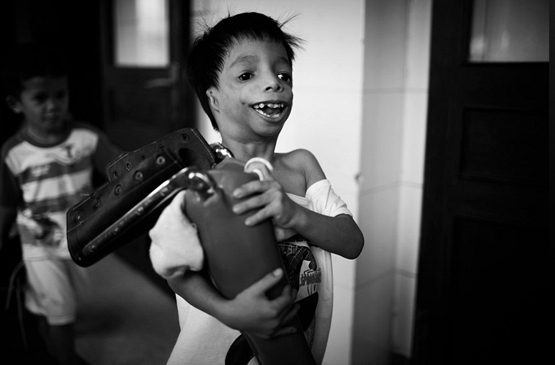
Cuando llegamos a Saigón, sabíamos que nos íbamos a encontrar con lo más duro de la guerra, pero nunca con algo tan escalofriante y atroz: el Agente Naranja. Caminando los estrechos callejones de la zona más antigua de la ciudad comenzamos a ver gente discapacitada y con malformaciones andando por las calles. Algunos mendigando, otros vendiendo libros y los más osados andando en moto a pesar de no tener ninguna de las dos pernas. Ciertos rostros eran algo similar a la idea que tenemos de un mutante. Narices gigantes que ocupaban más de media cara y con los orificios de lado, ojos que parecían chorreados y grandes inflamaciones como pelotas en las frentes y cabezas, orejas del tamaño de una moneda y dientes que crecían sin dirección alguna. Sobre una tabla con ruedas algunos andan sin piernas y un solo brazo, y otros con las extremidades retorcidas como rama de enredadera, con granos en la cara del tamaño de uvas o canicas. No teníamos en claro el porqué de toda esta gente, hasta que al segundo día de estar en la ciudad nos dirigimos al Museo de Remanentes de Guerra.
Victimas (www.forum.goregrish.com)
Al llegar al segundo piso, luego de ver aviones, tanques, helicópteros y armas, nos encontramos con algo que no esperábamos ver. Tras el vidriado de las paredes de la sala se observaban personas limpiándose las lagrimas de los ojos con las manos, mientras leían aterrorizados carteles que se encontraban en las paredes y observaban fotos que no eran del tiempo de la guerra, sino actuales. Dichas imágenes mostraban las más terribles malformaciones de seres humanos que sin siquiera haber vivido durante esos años, hoy sufren las consecuencias de una guerra que parece no tener fin.
Victimas (www.forum.goregrish.com)
Rompiendo tratados de guerra y leyes internacionales, el ejército estadounidense utilizo durante incontables ataques uno de los agentes químicos mas fuertes existentes en el planeta; el Agente Naranja. La selva era muy hostil para quienes no estaban acostumbrados a permanecer en ellas durante tanto tiempo, y a su vez hacia casi imposible localizar al Viet Cong replegado entre la densa vegetación que cubre gran parte de la península. Por otro lado el tránsito de la ruta Ho Chi Minh representaba una amenaza ante los americanos, quienes nunca pudieron cortarla por completo. Esta ruta transitaba gran parte sobre la frontera con Laos (incluso sobre territorio extranjero), y se movía siempre entre la espesa selva donde el Viet Cong era imbatible e ilocalizable. Suministros, refuerzos y tropas enteras transitaban de norte a sur por este sendero que se transformaría en una de las claves de la victoria norvietnamita. La única salida que vieron los americanos ante este terreno que se les hacia tan hostil, fue lanzar toneladas y toneladas del Agente Naranja desde aviones, un químico tan potente que destruía toda vegetación que tocaba, transformando selvas enteras en cementerios de arboles; las tierras fértiles de los valles en tierras toxicas e inutilizables; y centenares de ríos en canales que no transportaban más que veneno puro. Pero los aldeanos no lo sabían. Seguían consumiendo de esa agua, cosechando y comiendo de su arroz y vegetales que crecían en esos campos y hasta a veces mojándose con esa lluvia de químicos que llegaba desde el cielo. Solo unos pocos cercanos a grandes ciudades tenían la información de no consumir ni agua ni cultivos de sus tierras, pero el hambre llegaba rápido, y la destrucción de caminos y fabricas hacia que rápidamente se vean desabastecidos; obligados a comer lo que tenían a su alcance. Incluso sus animales, como cerdos, gallinas y vacas, bebían esa agua y comían de ese pasto, por lo que cualquier tipo de alimento era veneno en sí mismo.
Las fotos retrataban gente de todas las edades; ancianos, adultos, niños y bebes con malformaciones inexplicables. Me fue imposible retener las lágrimas al leer una carta enviada por una adolescente victima del Agente Naranja al Presidente Barak Obama, reclamándole ayuda y algún tipo de contemplación para las miles de personas en Vietnam que sufren estas esquirlas tan profundas que el tiempo no sabe curar. Sus vidas se ven resumidas a la existencia absurda donde nada de lo que desean puede ser realizado. El gobierno les recomienda no estudiar, su cuerpo les imposibilita realizar actividades laborales, se les hace muy difícil hacer amigos y casi imposible encontrar pareja; sabiendo que tampoco procrear es posible para ellos, ya que sus hijos saldrán con mayores malformaciones que las de ellos mismos. Un Agente Naranja que causo y sigue causando victimas no solo en los habitantes de Vietnam del Norte, el enemigo, sino también en Vietnam del Sur, Laos y Camboya.
Caida de Saigon (www.pictureshistory.blogspot.com)
Hoy en día miles de campos siguen siendo inutilizados y los análisis de agua de los ríos siguen dando como resultado la contaminación con agentes químicos que la hacen imbebible. Cientos de niños siguen naciendo con malformaciones sin que ninguno de los responsables tome cartas en el asunto. El país entero fue devastado, la mayor parte de sus puertos destruidos, sus rutas destrozadas y fabricas demolidas por una guerra absurda como todas. Tan absurda como las palabras del general Cao Van Vien, quien firmo la orden de resistir con la frase “defender hasta la muerte, hasta el final, la porción de tierra que nos queda”, desertando horas después y huyendo del país mientras sus soldados morían sin sentido. Tan absurda que la entrada de los tanques en el Palacio de la Independencia tomo por sorpresa a los periodistas quienes no estaban en el lugar, por lo que fue repetida horas más tardes, solo para las fotos, rompiendo los mismos enrejados que habían traspasado horas atrás. Sin embargo, la sonrisa del vietnamita es algo que no pudieron borrar de sus rostros. Gente amable, gente sufrida pero con esperanzas, gente que nos sonrió y ayudó durante todo el camino; ofreciéndonos su hospitalidad y no guardando rencores ante exponer un pasaporte americano. Un país que de a poco supo levantarse y hacerle frente a esta guerra que no tiene fin; esta Guerra que aun continúa.
Recomiendo cliquear en el link que aparece en el texto, o aquí, para leer la carta enviada al Presidente Barak Obama. Esta en ingles pero cualquier traductor puede realizar una traducción bastante cercana a la realidad.
As soon as we crossed the Chinese border, we knew that we were in a country with tremendous population. Every little bit of land, and all the way to the rail ways was taken up by some sort of crops growing everywhere. China met us with sunny skies, warm breeze and hundreds of Chinese coming and going at the main train station square. Arriving to Beijing from Ulan Bator was like making a leap of a couple of decades. Beijing, in contrast with Ulan-Bator, is a very modern, developed and organized city which offers all of the modern comforts without losing its historic flavor. It is enormous and it seems that there is no end to this concrete jungle, however, we did not feel this, even though we stayed in one of the central districts of the Chinese capital. Our Chinese home ended up being a hutong apartment of a Portuguese-Canadian.
Being Chinese.
Chris met us at the Jishuitan station. We did not have the exact address and Chris insisted on us calling him when we were at the station. Of course, we did not have a phone and this was our first country where neither of us spoke a word of the local language. Taking turns we stopped a number of pedestrians pointing at their cell phones. Finally one young girl responded in English offering to borrow her iphone (everyone has an iphone and a professional photo camera on them at all times in Beijing). Three minutes later a guy in shades and a black leather jacket greeted us with a sudden “que pasa?!”. We were taken a back for a second but recovered immediately remembering that the guy was half Portuguese. He didn’t really speak Spanish, but he liked to try. We followed him into a narrow alley, then another one, and another one slowly realizing why Chris insisted on meeting us without giving us the exact address. There was no way in the world that we would have found our way in a maze of those hutons.
Old time hutongs.
A huton is a historical district where people live in traditional houses which had sprouted chaotically in no organized manner, and which keep on expanding forming labyrinth-like shantytown with no central sewage system. Why would I care about sewage? Well, I really don’t unless it complicates my life in a very direct way. Chris’s hutong, just like any other hutong, does not have private bathrooms, which means that every time your body is ready to discard its byproducts you get to go to one of the community outhouse and share this special private time with about 4-9 neighbors happily chatting about the latest rumors, smoking, or playing games on their iphones. Oh no! There are no individual stalls or any sort of devisors between the actual toilets, so you just make your bottom comfortable in a squat position right next to your new Chinese friends.
Besides the minor bathroom time inconvenience Chris’s place was just perfect for our needs. It was right in the center of all of the main attractions of the city and only 3 minutes away from a metro stop.
Inside the Forbidden City.
Since Beijing was a huge city and our only stop in China we decided to spend at least a week there to visit its sights and try to feel through what it is like to live in this gigantic Chinese metropolis. During the day we went about town discovering its treasures like (The Temple of Heaven, the Olympic Village, the Forbidden City and such) and at night, when Chris was back from his lessons (he is an educator of some sort), we all went out for a taste of Beijing in one of its many restaurants. Sometimes they were actual restaurants where we drank obligatory rice wine shots (Chris strongly believes it the disinfecting qualities of alcohol) and ate elaborate dishes with weird tastes. Other times they were just street stalls which magically produced tables and chairs and fed us its kebobs made of unknown substances. Food was always very interesting, however not always agreeable with my stomach. Whether it was the abundance of oil which is used for preparation of practically everything, or the strange herbs that I have never tasted before, but more than once I had bathroom (hutong style, of course!) consequences after those wonderful dinners.
Beijing Night Market.
One time Chris also took us to a local food market and showed us how negotiating is done in Mandarin. After 5 years in Beijing Chris spoke Chinese Mandarin pretty much like a local and knew all ins and outs of the city and its Beijing urban culture. As it turned out, it was pretty important to have someone local, or at least Chinese-speaking to guide us around and bargain down the prices. The locals are quite opportunistic and will rip you off if you are not paying attention or not familiar with their prices. The cabs are absolutely ridiculous. First they do everything possible to not understand where you want to go even if your destination is 10 blocks away and you are pointing at the exact address on a map written in Mandarin, then they refuse to use the meter, and when you finally manage to negotiate the right price and the cab begins moving you realize that the driver is somehow unfamiliar with the area and insists on taking you to your destination taking a detour of at least 30 minutes.
A rare clear sky sunset in Beijing.
Luckily, we only had to use a taxi 2 times, one when we were off to the train station on our way to Hong Kong, and the other when we went to meet with Diego, my friend’s cousin. I have never met Diego, and did not even know that my friend Manuel de Rivera had a cousin who not only lived in Beijing, but also worked there as a reporter for one of the Spanish TV channels. As it goes with the Spaniards, after a quick introduction over the phone we were invited to a dinner and a party with a flamenco singer performance at one of the bars frequented by Beijing expats. Diego turned out to be very charming and welcoming somehow making me feel as if I were at some bar in Madrid, surrounded by Spaniards drinking wine, smoking cigarettes and chattering over the crying sounds of flamenco. Diego told us that there were expats in Beijing of all sorts and that no matter what people did they found a way to make a good living there. The city seemed booming with everything, from commerce to fashion, and from international work to construction industry.
At the Temple of Heaven.
Beijing was bustling and hustling no matter where we went. It also seemed to be flooded with tourist groups, especially Chinese ones. Mid fall is the “golden time to visit Beijing”, as we have discovered later, and many Chinese take their short vacation during that perfect time of year to visit the nation’s capital. Apparently, they don’t like to travel individually, and together in an organized group it also tends to be cheaper. As their vacations are short, the tours are usually short as well, but they are as condensed with activities as can possibly be. A typical tour of Beijing would be one or two days with visits to the Forbidden City, The Temple of Heaven, some parks, the Olympic village the Great Wall and, of course, a dinner of the famous Beijing duck. In size, the Chinese groups could only compare with Russian speaking groups. I was very surprised to hear as much Russian in Beijing as I did. It appeared that Beijing was one of the new hot destinations for vacationing Russians, whom I could identify anywhere, whether I heard them speaking Russian or not. No group was without a typical middle age woman of about 100 kg, wearing a see through shirt, large sun glasses with sparkles and an awful haircut. There was always a man in his 40s with very pale skin beige color shorts, back socks and sandals, tugging behind himself an identical copy of a son. And, of course, no tour could go without a group of 3-4 bolding men in their 30s-40s with beer bellies, cigarettes in their mouths and terrible smell of sweat floating behind them like an invisible cape of people repellent. We spent a week visiting all of these places and it still felt rushed, especially because I were constantly forced o fight for space with the never ending tour groups.
The Spectacular Bird's Nest.
One afternoon, returning from another museum we found ourselves in a beautifully groomed park which was full of people. There were some obvious tourists, but the majority were locals who were intensely involved in activities. It seemed that that park was a meeting place for people to practice their hobbies and socialize. There was a terrace for card players and Chinese chess lovers, there was an “exercise station” with different cardio machines (with free access), there were open spaces full of older people practicing Chinese gymnastics (very weird looking set of activities when you swing of arms and hit yourself on different parts of your body), there were others who stood in circles and played hacky-sac with a mysterious device which had feathers and flied like a badminton shuttlecock (which they were ridiculously good at).
A woman in a Bejing hutong.
All of this business was very different and terribly exciting, but the most impressive of all activities was opera singing. I know, it is weird to be polishing your arias of Aida in a public park, but that is what they do in Beijing. First, we thought that we did, in fact, stumble upon a group of professional opera singers practicing their singing in the park just for the hell of it, but then we realized that there were many of those groups, each with an accordion player, and some competing with each other (let’s sing our loudest to outsing those around that bench right next us). It was amazing how good some of those singers were, and they were just amateurs, who came to the park to hand out and sing. In fact, if you knew the songs and were willing to sing, you could spend a day doing progressive singing floating from one group to another. We found the group whose singing we liked the most and spent almost two hours sitting on the grass, enjoying their musical vibrations.
The Great Wall at Badaling.
Another popular activity which we absolutely could not skip in Beijing was hiking around the Great Wall. From the pictures I have seen of the Great Wall I have always pictured it very serene, mysterious and empty. This, naturally, was not what we saw in reality. It was overflowing with tourist groups (the Chinese ones insisting on taking a photos with us every 2 steps), the entrance was almost barricaded with endless shops and kiosks selling horrendous memorabilia, and it was terribly hot under a blazing October sun. In other words, it was a “Historical Disney World”. Nonetheless, we were determined not to get disappointed by any of that. When you go to the Great Wall, you are actually allowed only to a certain closed off part of it which you can march through back and forth all day if you want to. We discovered that one complete walk through, with its gigantic stares taking you up and down and up and down the wavy pattern of the Wall, was enough to tire you out. It is a mystery to me why they built that Wall almost zigzagging and not just straight across the mountains. To me, the straight wall would have been just as good of a protection against the Mongols, who were constantly trying to get that northern chunk of China for themselves. The Mongols eventually got the Chinese anyways, and the Wall just stayed there as an amazing 3000 kilometer monument of human obsession with territorialism.
These are the best street snack!
After the Great Wall and all of the other attractions that we have seen in Beijing we needed some time to digest it, as well as prepare our nest move. We spent the last couple of days buying tickets, packing and reading about our next destination - Hong Kong. An overnight train took us from the Northern Capital (which is the lateral translation of Beijing) to the city of Shenzhen, a border city and another huge Chinese industrial metropolis.
We were minutes away from our final stop on Olkhon Island, the biggest of the 22 islands of Lake Baikal, and also considered one of the most sacred places in Buddhist Asia. It was getting late and we needed to get to where we were staying that night before it was pitch dark and there was no one in the street. I called Sergey (our host on the island) to verify the address.
– Yes, the house behind the church. Just come on in! – replied Sergey.
5 minutes later I was knocking on the door of the house behind the gorgeous Russian Orthodox Church overlooking the steep hill cascading into Baikal. "Bon jour!" – was the response of a friendly blond lady, who opened the door and retreated to continue some table game with 2 children and 4 outdoorsy looking adults of different ages.
Emi and Yura with their pikes at the "Turbaza".
To put it mildly, we did not expect to find a house full of French travelers in the middle of Russian Siberia, especially not at this refuge-shack administered by a 30ish year old Russian church guardian. The lovely French found Sergey the same exact way we did – on Couchsurfing.com. I have heard about the site some years ago, when my old housemate (without consulting his roommates) opened the doors of our house to a Finish couple, who turned out to be wonderful and loved Washington DC. I never gave this idea much thought until Emi and I began our expedition. Emi, as it turned out, was registered on the site, but has never used it before. Since Latin America is cheap and with plenty of hostels we never thought of becoming active couch surfers until we got to Russia. Our first intention was to have a place to stay and save money on hotels, but once we had our debut with Ksenya in Krasnoyarsk, we became loyal converts.
Emi, Lisa, Marco and I in Terelj National Park, Mongolia.
It is basically a cultural exchange-meeting place for people who like to socialize. You can stay with people when you travel, you can host people at your home if you stay put, or you can just offer to hang out or show your local sites to the foreigners passing through where you live. At Ksenya’s in Krsnoyarsk, we learned that she loved hosting people just because it gave her a special spice in her daily life and she got an opportunity to practice English. She hosts people in her one bedroom apartment where the guests get the bedroom and sleep on mattresses on the floor, and she and her boyfriend do the same in the living room. She has very little, but still she chooses to share that little with the fellow travelling souls that came through her nostalgic Siberian town.
Lisa in our ger.
In the case of Sergey (college educated in Russia and France), he felt that it made him more connected with the world when he received people in his island house, especially if he could practice his French and English while showing them around. When Sergey moved to the island some 6 years earlier to restore and revive the local church, there was no housing either for him or for any travelers. Little by little, him and his wife built a little log house and began thinking of a guest reception/cafeteria area, which every Russian church is supposed to have. Sergey did the thinking and couch surfers did the action.
Hong Kong - floor 62.
When Sergey began hosting people, everyone felt it was their duty to help with construction. As long as Sergey found building materials, the guest house did not stop to grow. When we were there, the structure was in place and only in need of insulation and interior beautification, to which we contributed almost every day of our stay. We also built a 15 meter long fence to protect the church grounds from the fierce winds ruling those lands. Every day when we returned to our new home after routine explorations of the island we (alongside with our French housemates) Iooked for new improvement projects. Just like at any other country-set household there is no end to activities and chores: there is wood to be split, garden to be weeded, shacks to be built and walls to be painted. No matter how cold it was, or how tired we were we did the work with great pleasure and felt that we were contributing to a common good that will stay and grow.
Our hutong street in Baidjing
Our Severobaikalsk stay with Yuri was just as different and as fulfilling as the days with Sergey. Yuri, hosted people at his friend’s country camp, where he also lived for the time being. He was the only person from Severobaikalsk to host people, and he tried to accommodate everyone. Besides the excitement of meeting new people Yuri also “used” his guests to help him brain storm about tourism opportunities in northern Baikal where he was starting his travel company. Our contribution to Yuri’s new enterprise was in the form of photos for his website and a presentation video, which travelled to Moscow’s Young Entrepreneur’s competition which Yuri successfully won.
Chris is helping Emi to negotiate some deal in Mandarin.
There were many other stops along our way at the houses of great couch surfers. Liza from Germany, who hosted us in Ulan-Ude, became our dear friend and joined us on a trip to Mongolia where we spent a fun weekend in a ger of a local nomad family. Chris from Canada, “the master of Beijing hutongs”, taught us all there is to know about tea drinking and showed us how to do Chinese-style grocery shopping at the neighborhood market. Ting Yan from Singapore, who showed us the wanders of living on 62d floor in a Hong Kong residential neighborhood. The experiences that really stood out for us were the ones where we could help or contribute in one way or another, which always happened for us spontaneously and unexpectedly.
Anyone wants to start an export business: Beidjing-Moscow?
Since the beginning of our trip I have been looking for ways to help in places that we visited. The reality that I have discovered was that many volunteer projects have become an alternative way of travelling, where a volunteer has to pay a substantial fee in order to work for free. Administering volunteer projects takes time and effort and that is what the fee covers (they say). However, isn’t it ridiculous that your efforts to help are rejected if you can’t pay the fee?! It is the first time in my life when I have plenty of time and energy that I can and want to devote to helping this world, and I can’t find places where I can volunteer without having to pay for it.
Not surprisingly, Couchsurfing became for us the way to find people who needed help and who at the same time were willing to host us. It looks like Couchsurfing might become a new way to find real grassroots volunteering where it is still raw and clear cut: volunteering means donating your time and efforts to help those in need.
Eran tiempos de guerras e invasiones en Asia y los chinos desplegaban su potencial marítimo sobre la península de Indochina. Toda la costa este era amenazada por una de las flotas más extensas y poderosas del continente. Situados en el Golfo de Tonkín, cientos de navíos esperaban órdenes para atacar y comenzar la conquista; pero el Emperador de Jade recurriría a las fuerzas divinas de sus dioses para la defensa y contraataque. Aprovechando el tener al enemigo reunido en un área reducida, envió una familia de dragones celestiales para ayudar en la emboscada final. Escupiendo joyas y jade alrededor del enemigo, el grupo de dragones lanzaba su poderío en las aguas del Mar de China Meridional, joyas que se convirtieron en islas e islotes alrededor de la bahía, uniéndose para formar una gran muralla frente a los invasores, permitiéndole a su armada hundir la totalidad de los barcos enemigos y expulsar definitivamente a los chinos de sus aguas. Vietnam daba sus primeros pasos como nación y la bahía de Ha Long, literalmente “dragón descendente”, emergía sobre la superficie.
Techo de una de las Cuevas
Sobre un casco de madera bastante antiguo y con la ayuda de un ruidoso motor diesel, nuestro barco navegaba lentamente entre las casi 2000 islas que forman el archipiélago de Halong Bay. Gigantes masas rocosas emergen a la superficie hacia cada uno de los puntos cardinales, dejando entrever el horizonte solo en algunos pequeños espacios libres. La erosión del agua sumada a la cualidad química de descomposición de estas formaciones kársticas, generan formas a veces contrarias a la física, donde la parte superior de las islas, es más ancha y grande que la parte sumergida; como si pusiésemos una pirámide invertida, esperando que esta logre el equilibrio. Enormes cuevas formadas gota a gota con el paso de miles de años, otorgan imágenes donde las rocas se convierten en telas que cuelgan del techo entre estalactitas y murciélagos.
Amanecer
Desembarcamos durante unas horas en la isla de Cat Ba, la más grande de la bahía, donde se extiende el parque nacional del mismo nombre, casa de un grupo de extraños monos de cara blanca; los languru. Lamentablemente solo los vimos en fotos, pero disfrutamos el ascenso a la parte alta del parque, desde donde es posible apreciar gran parte de la isla, en su mayoría selva, dominada por cerros no muy altos que dejan ver sus rocas entre la vegetación. A su vez, esta es la única isla habitada del archipiélago, con algunas poblaciones, hoteles y playas.
Atardecer en Halong Bay
Lamentablemente la belleza de la bahía se ve opacada por la mala organización y servicio de los tours que se ofrecen para conocer la ahora elegida como una de las siete maravillas naturales del mundo. Comida escasa, guías que solo acompañan al grupo, ya que es imposible sacarles información alguna sobre nada, sumados al malhumor y la mala predisposición de los viajeros que en más de una vez se sienten estafados. Por otra parte, es imposible recorrer la zona por tu propia cuenta (a menos que tengas un barco propio), por lo que es inevitable caer en manos del poco serio turismo vietnamita. Da pena porque creemos que podríamos haber disfrutado muchísimo más de la bahía y sus inigualables paisajes, aunque de todas maneras, no podemos negar que durante las dos noches que pasamos en el barco, nos vimos navegando aguas de piratas y envueltos entre jade y joyas, que solo dragones celestiales fueron capaces de lanzar.
Cuando planeamos el viaje sabíamos muchas cosas de Sudamérica, Rusia y Estados Unidos, pero nuestros datos de Asia; más específicamente del Sudeste Asiático, eran mínimos y se reducían a algunas rutas a seguir, ciertos puntos imprescindibles, y los datos de visados que necesitaríamos o no en cada uno de los países en cuestión. Es por eso que cada vez que nos encontrábamos con alguien que ya había viajado por la zona, los llenábamos de preguntas para de a poco armarnos de una idea más precisa sobre nuestro posible itinerario. En lo que respecta a Vietnam, todos, y absolutamente todos a los que les preguntamos nos dijeron “no se pierdan el norte”. Pero de qué manera podíamos abarcar una gran zona viajando en buses? Que escalas haríamos? Es difícil a veces conocer algo diferente si no salimos un poco de estos saltos de ciudad en ciudad que representa el transporte público. Pero una pareja de catalanes nos soluciono la incógnita: “alquilen una moto”.
Fumando Tabaco
Así fue que con los cascos ajustados, alforjas cargadas, un buen mapa y piloto para lluvia bajo el asiento, pusimos en marcha la Honda 125 y esquivando vietnamitas comenzamos nuestro periplo norteño; con los ojos bien abiertos y cargados de expectativas. Nos tomo más de dos horas salir de la ciudad; si se puede decir que salimos, ya que las casas a los costados de la ruta son una constante que rara vez desaparece. Motos, camiones, bicicletas, gente caminando por las banquinas; las rutas de Vietnam son calles donde se desarrolla la vida hasta más lento que en las ciudades, a una velocidad más de pueblo: pausada y parsimoniosa. Dos veces nos cruzamos con accidentes con motos, aunque los conductores se paraban sin siquiera mancharse la camisa y volvían al ruedo sin discusiones de por medio. Pasado Hoa Binh, nos detuvimos a almorzar en un restaurante donde algunos locales tomaban sopa. Señalando sus platos ordenamos lo mismo, mientras de a poco intentábamos intercambiar algunas palabras con los otros comensales. Risas de por medio les pedimos una foto, a lo que aceptaron con mucho entusiasmo y nos pidieron que nos sentásemos a tomar el té y fumar algo de tabaco con las grandes pipas de bambú que usan en Vietnam. Era el primero de nuestros almuerzos en la ruta, el primero de tantos almuerzos inolvidables que iríamos a tener durante nuestro trayecto. Almuerzos con charlas sin sentido. Pero qué sentido tiene que tener una charla si alegra corazones? Ya bastante sentido le buscamos a la vida todo el tiempo; porque no tomarla a la absurda cada tanto?
Cosecha de Arroz en Mai Chau
Luego de 6 horas (bastante para el primer día), llegamos finalmente a Mai Chau, pequeño poblado donde nos habíamos propuesto pasar la primer noche. El pueblo vive básicamente del arroz y de las telas que venden sus mujeres a los turistas que se acercan por la villa. Mai Chau es hermoso por donde se lo mire. Casas de madera y bambú sobre altos pilotes forman las escasas edificaciones alrededor de gigantescos campos de arroz que descansan a los pies de algunos cerros. Grupos de mujeres cosechan el “oro blanco” en manojos que atan con pequeñas ramitas de la misma planta. Luego los hombres recogen estos manojos y juntándolos en grupos más grandes los transportan en sus hombros o en motos hasta sus casas en el pueblo. Con diferentes técnicas separan los granos de arroz de las espigas; algunos caminando sobre ellas, otros con rodillos manuales y los menos con maquinas a diesel, para luego ponerlos a secar a los lados del camino.
Mujeres Trabajando
El norte de Vietnam es característico por albergar la mayoría de las 54 diferentes etnias que habitan en el país y fue a partir del segundo día cuando comenzamos a distinguir muchas de ellas por los pueblos a los costados de la ruta. Las miradas curiosas desde los arrozales de mujeres de la etnia Red Dzao, un grupo de niños de la etnia White Hmong montando búfalos por el medio del camino, saludos de mujeres de la etnia Black mientras sacaban cangrejos de uno de los tantos ríos turbios que serpentea el sur de la provincia de Son La; mas y mas pobladores de grupos aborígenes que fueron capaces de resguardar sus culturas por miles y miles de años. Vestidas con sus tradicionales trajes negros con decoración en varios colores en las mangas y un pañuelo verde en las cabezas, caminaban algunas niñas de la etnia Green Hmong bajo la sombra de extensos viñedos que tapizaban las laderas de los cerros, mientras mujeres de la etnia Muong, distinguidas por sus largas polleras negras ajustadas, camisas blancas o celestes y pañuelos blancos en las cabezas sobre sus rodetes, trabajaban con sus abejas y plantaciones de té. Un bombardeo constante de ropajes de colores, peinados extravagantes y miradas que dejaban escapar cierta ternura y timidez, nos abofeteo durante las 8 horas que estuvimos sobre la moto.
Cosecha de Arroz
El tercer día nuestro trayecto sería el más corto del periplo y luego de algunas 4 horas, recorrimos los 136km que separan Thuan Chau de Dien Bien Phu, ciudad heroica en Vietnam, ya que fue allí donde en 1954, el en ese momento Vietnam del Norte, ganó finalmente la batalla más importante contra los colonos franceses, expulsándolos definitivamente de su territorio. Es quizás en este tramo donde vimos más fuerte y constante el trabajo en la ruta misma, y cuando digo en la ruta misma no me refiero a trabajos de pavimentación ni mucho menos, sino a trabajos cotidianos del campo que los pobladores desarrollan directamente en las banquinas; más específicamente, el secado de granos y otros alimentos. Sobre grandes lonas secan arroz, maíz, hongos y algunas raíces y frutas que usan para las comidas, mientras grupos de chicos vuelven en bicicleta de la escuela. Es importante destacar que durante todo nuestro viaje no vimos un solo chico trabajando, sino que siempre aparecían cerca del mediodía, con camisas blancas y pantalones o polleras azules, volviendo a casa con sus libros en los canastos de las bicis.
180 Grados
De a poco nos acercábamos a Sapa, nuestro punto final antes de la vuelta a Hanoi, y la ruta cada vez más montañosa, no le daba respiro a la pobre Honda. El subir y bajar montañas hace que desaparezcan un poco las riquísimas etnias que coloreaban los campos en días anteriores, pero a su vez los paisajes se magnificaron al 100%. Era como si por momentos los ropajes de la gente y nuestra curiosidad por sus actividades, le dejaban espacio a los ríos y montañas para que estos puedan ser apreciados sin distracción alguna. Una pared de helechos gigantes cubre por completo la ladera de un cerro a nuestra derecha, mientras a nuestra izquierda y bajo un precipicio bastante profundo, un rio turbio color café con leche, se mueve pacíficamente y en absoluto silencio. Algunos barcos con rodillos gigantes, levantan los sedimentos del fondo lacustre en busca de oro u otros minerales. Los paisajes se sucedían uno tras otro y solo al bajar a los valles volvíamos a cruzar miradas con etnias que nos saludaban con sonrisas al grito de “hello”. Fueron dos días con los paisajes más sorprendentes por las provincias de Lai Chau y Lao Cai, transitando rutas de ripio bastante malas y moviéndonos entre las tinieblas que abrazaban montañas de piedra cargadas de vegetación. Tinieblas que al mediodía del 5to día nos depositaron finalmente en Sapa.
Transportando la Cosecha
Debido a la abusiva explotación turística Sapa es sin dudas la ciudad más cuidada y más bonita en el norte. A su vez, es donde las etnias perdieron un poco su esencia, comenzando incluso a hablar algo de inglés y dedicándose más al turismo que al campo en sí mismo. El acoso es permanente y sin fin sobre turistas que se acercan para preguntar un precio o simplemente para ver algo de lo que venden. Son las mujeres mismas de alguna de las cuatro principales etnias que habitan la zona (Miao, Dao Do, Tay y Giay), quienes se encargan de caminar junto a grupos de viajeros que quieren introducirse más en las increíbles e incontables terrazas de cultivo que rodean Sapa por los cuatros puntos cardinales. Son estas terrazas las que hacen de Sapa un lugar diferente.
Terrazas en Sapa
Rodeada de las montañas más altas de Vietnam, Sapa en sí, es un lugar complicado para la práctica de la agricultura debido a que no existe valle alguno y la única solución es recurrir a las terrazas de cultivo, las cuales también hicieron famosos a los Incas en el glorioso Perú. La única diferencia entre estas etnias y el antiguo imperio sudamericano, es que en Sapa, esto se sigue practicando en la actualidad y la cantidad de terrazas es algo imposible de calcular. No existe ladera que no represente estas gigantescas escalinatas cargadas de arrozales. Por otra parte, la dificultad de realizar esto con el arroz, es que este necesita ser inundado al momento de la siembra; como formando enormes piletones. De esta manera las terrazas no son solo simples escalones, sino a su vez representan una obra de ingeniería, donde de arriba hacia abajo se van llenando dichas piletas de cada nivel, rebalsando uno al otro hasta llenar de agua incluso la zona más baja de la montaña. Son diques colgantes que luego serán utilizados para el sembrado y cosecha de mucho del arroz que se consume en el país.
Etnia Miao frente a las terrazas de Sapa
Contra la lógica de un viaje al norte de Vietnam, y luego de pasar el día completo en Sapa, seguimos viaje para pasar la noche en Lao Cai, ciudad frontera con China. Durante los 34km que separan ambas ciudades el camino bordea un rio correntoso colgando de la ladera sur de las montañas y bajo la sombra de grandes y oscuros pinos. Al otro lado del cañadón es posible ver terrazas plagadas de arroz ininterrumpidamente durante todo el trayecto, sabiendo que de nuestro lado, posiblemente la ruta sea un nivel más de las infinitas escalinatas verdes. Finalmente llegamos a Lao Cai, y nos dispusimos a descansar temprano, ya que al día siguiente nos esperaba la larga vuelta de casi 340km hasta Hanoi.
Abuela de Sapa
Esta ruta, representa una de las principales vías de comercio con China, por lo que el pavimento se encuentra en mejores condiciones y sin tantas montañas, de manera que nos fue posible transitarlo con mucha mayor velocidad. Pero también fue en estos últimos kilómetros cargados de mucho mas transito, donde vimos las maniobras más extrañas y las atrocidades más grandes en cuanto a transito se refiere. Camiones yendo marcha atrás, un derrumbe que ocupaba tres cuartos de la ruta, retomes sin ningún tipo de aviso previo y vehículos estacionados directamente sobre el pavimento, mientras sus choferes almorzaban en algún restaurante al lado del camino. A eso hay que sumarle que nunca van por su carril, sino que siempre transitan ya sea por el medio o directamente de contramano. Ya ingresando en la ciudad y mientras recorríamos una autopista, una vaca caminaba libremente como si fuese parte del tránsito, mientras un grupo de motos y un colectivo lo hacían de contramano.
Bufalo
Finalmente, luego de seis días y 1264km recorridos, volvimos al punto de partida, completamente satisfechos y agradecidos por el clima que nos acompaño durante todo el trayecto, dejando caer alguna llovizna solo durante algunos minutos luego de la salida de Lao Cai. Sin dudas conocimos mucho mas de Vietnam de lo que se puede conocer sobre buses y trenes, quedando claro que de aquí en más alquilaríamos una moto siempre que nos fuese posible. Coloridos días que no olvidaremos jamás, dejando grabado en nuestro ser los saludos de los niños en bicicletas, las verdes terrazas de arrozales, los increíbles y graciosísimos almuerzos, los revolcones de los enormes búfalos en el barro y las incontables sonrisas que nos regalaba cada persona con la cual nos cruzábamos. Días donde conocimos el verdadero Vietnam, y la vida del campo de este golpeado país donde su gente es el ejemplo de la esperanza y la ilusión.